
The Silent Vault
An underground archive was discovered. The shelves showed decades of use. Nothing remained.
Investigation 203
The Silent Vault
SECTION 01 · Recovery
Research Summary
The excavation team expected another storage room.
They found an archive.
The shelves showed decades of use.
The environmental systems were still running.
Every shelf was empty.
The report follows.
Day 12
Subsurface anomaly confirmed.
Day 15
Primary chamber identified.
Day 17
Controlled entry authorized.
Day 17
Environmental stability confirmed.
Day 18
Structural survey completed.
Day 19
Collection absence verified.
Day 24
Investigation transferred to the Office of Archive Integrity.
SECTION 02 · Evidence
Exhibit A — Structural Survey
The chamber measures approximately 18.2 meters in length and 11.4 meters in width.
Four parallel shelving aisles divide the interior into five walkable corridors.
Independent ventilation channels remain unobstructed.
Humidity regulation systems continue to operate despite the apparent age of the structure.
No evidence of flooding, combustion, structural collapse, or seismic disruption has been identified.
One hundred twenty-eight shelving positions were documented.
No preserved objects occupied any shelf at the time of recovery.
The structural condition of the chamber is inconsistent with surrounding excavation layers.
Internal Length
18.2 m
Internal Width
11.4 m
Maximum Height
3.8 m
Shelf Positions
128
Occupied Positions
0
Humidity
31%
Temperature
18.4°C
Environmental Controls
Operational
Visible Collection
None
Structural Integrity
Stable
Evidence Confidence
High
SECTION 03 · Evidence
Exhibit B — Shelf Analysis
Microscopic residue recovered from shelving surfaces indicates prolonged contact with manufactured storage objects.
Residue distribution remains remarkably consistent across all shelving positions.
Recovered wear patterns suggest repeated placement and removal of objects of nearly identical dimensions.
No fragments of paper, textile, polymer substrate, wood, ceramic containers, or metallic storage hardware have been recovered.
The shelving exhibits measurable surface polishing consistent with long-term human use.
No known preservation model adequately explains the complete absence of stored materials while preserving evidence of sustained occupation.
Current evidence supports the conclusion that the chamber housed an organized collection.
Current evidence does not explain the collection's absence.
Sampling Locations
128
Positive Residue Samples
124
Negative Samples
4
Organic Material
None
Cellulose
None
Polymer Fibers
None
Metal Fragments
None
Container Residue
Detected
Source Material
Unknown
Evidence Confidence
Moderate
SECTION 04 · Evidence
Exhibit C — Catalog Markers
Catalog markers were recovered throughout the western shelving aisles.
Most remain severely degraded.
Six markers preserve sufficient surface detail for partial transcription.
None correspond to any known cataloging methodology currently documented within Archive Alpha.
Marker dimensions remain remarkably consistent despite differing preservation states.
No associated inventory survives.
No indexing records have been recovered.
The relationship between the recovered markers and the absent collection remains unresolved.
Marker 04
████ ████ ███
Translation Confidence
22%
Marker 11
RETURNED
Translation Confidence
81%
Marker 19
███ ████ / HOLD
Translation Confidence
39%
Marker 31
PRESERVE
NOT CONTENT
CONDITION
Translation Confidence
43%
Alternative Reading
PRESERVE
NO CONTENTS
Marker 56
INDEX PENDING
Translation Confidence
67%
Marker 77
████ ███████
Translation Confidence
18%
Current Status
Translation Incomplete
Translation Confidence
Variable
SECTION 05 · Evidence
Exhibit D — Wall Inscription
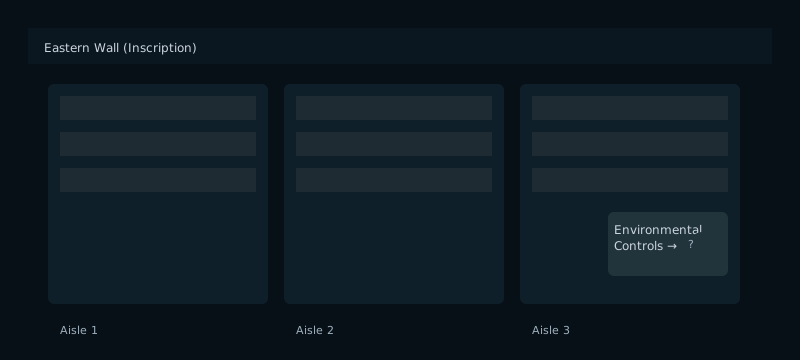
A single inscription survives upon the eastern interior wall adjacent to the chamber entrance.
Surface erosion has rendered approximately forty percent of the inscription unreadable.
Three independent translation teams have produced internally consistent, but mutually incompatible, interpretations.
No translation has been accepted as definitive.
Recovered Characters
████ ███ ███████
██ ███████ ████
████ █████
Primary Translation
We preserved what we could.
What remains was never ours to keep.
Translation Confidence
64%
Alternative Translation
We returned what we held.
What remains was never ours.
Translation Confidence
61%
Minority Interpretation
Nothing was preserved.
Only the chamber remains.
Translation Confidence
37%
Current Status
Translation Disputed
Evidence Confidence
Moderate
SECTION 06 · Evidence
Exhibit E — Environmental Preservation Systems
Environmental control infrastructure remains partially operational.
Humidity regulation continues to function within acceptable preservation tolerances.
Air circulation channels remain unobstructed.
Thermal fluctuations are substantially lower than those observed elsewhere within Archive Alpha.
No identifiable energy source has been recovered.
The preservation systems appear to have continued operating long after the chamber ceased active use.
The continued operation of preservation systems without an identifiable energy source remains unresolved.
Relative Humidity
31%
Temperature
18.4 °C
Air Exchange
Operational
Filtration
Operational
Structural Ventilation
Operational
Power Source
Unknown
Estimated Continuous Operation
Undetermined
System Integrity
Stable
07:42
Environmental systems confirmed operational.
08:15
Shelf residue sampling complete.
09:31
No collection recovered.
10:08
Catalog markers documented.
10:44
Wall inscription photographed.
11:26
Additional excavation suspended pending structural review.
Field Comment
Removed during Revision 2.
Reason:
Speculative observation not supported by recoverable evidence.
Evidence Collection Complete
Pending Comparative Analysis
SECTION 07 · Analysis
Initial Analysis
Investigation 203 documents a preservation chamber exhibiting several characteristics consistent with long-term archival storage.
Environmental controls remain partially operational.
Structural integrity exceeds expectations based upon surrounding excavation layers.
Residue analysis supports prolonged occupation of the shelving system.
Catalog markers indicate the former existence of an organized indexing methodology.
Individually, none of these observations are considered anomalous.
Taken together, they present a problem for current preservation theory.
The investigation therefore remains open.
Evidence Summary
Confirmed
✓ Room intentionally constructed
✓ Shelves heavily used
✓ Climate systems operational
✓ Collection absent
Unresolved
? What was stored here
? Where the collection went
? Why systems remain running
? Who built it, and when
SECTION 08 · Scholarship
Current Interpretations
Office of Archive Integrity summarizes three principal interpretations of the evidence below. No consensus has been reached.
SECTION 09 · Open Problems
Outstanding Questions
Investigation 203 presently leaves the following questions unresolved.
Why was the chamber constructed?
What constituted the preserved collection?
Why do environmental systems remain operational?
Why do catalog markers correspond to no recognized archival classification?
Why does residue indicate prolonged storage while no stored objects survive?
Does the chamber represent preservation failure...
...successful preservation...
...or an incorrect understanding of what preservation originally meant?
The available evidence does not presently permit a preferred conclusion.
Primary Scholarship
Treatise I
On the Preservation of Knowledge
(Current Revision)
Related Investigations
Investigation 047
Published
Investigation 482
Recovery Ongoing
Referenced Recovery
Archive Gamma
Recovery Status
Unrecovered
Referenced in recovered catalog marker 31
Scholarly Responses
None Published
Current Status
Open
OPEN INVESTIGATION
Current Scholarly Consensus
Contested
Mystery
If the room was built to preserve something...
why was the room preserved...
but not its contents?
Build Something Better
Ideas deserve a better home than a generic blog.
WebCraft Labz builds fast, polished websites for businesses and creators who want their ideas to feel premium from the first scroll.
Start a Project