THE UNDERSTANDING LAYER
The New Business Skill Is Understanding Systems
A forecast for the next decade of work. As AI absorbs the production layer of professional work, value migrates to verification and accountability. This essay sets out a three-layer model of work, the roles forming around it, the entry-level pipeline problem underneath it, and a working definition of systems literacy for business leaders who will never write code.
A forecast, not a report. Some of what follows is already happening, some is reasonable extrapolation, and some is a bet. Where it matters, I have marked which is which.
Picture a Tuesday morning in 2031.
A roofing company in Henderson runs on software nobody at the company wrote. An agent qualifies the leads. Another builds estimates from drone photos. A third schedules crews, orders material, and chases invoices. The owner didn't hire a developer for any of it. She described what she wanted, and it got built.
It has worked for eighteen months.
Then one week, close rates drop by a third and nobody can say why. The estimating agent has started pricing every shingle job as if it were tile. A supplier changed a product code, a lookup broke, and the system kept producing nicely formatted, completely wrong numbers. Nothing crashed. No alarm went off. The output looked exactly like correct output.
The question that matters in that moment isn't who can build software. Building it is no longer the hard part. It's this: who in this building understands the system well enough to notice it's lying?
I think that's becoming the most valuable skill in business, and most people aren't training for it.

PART 01 · The shift
From doing the work to understanding the work
For most of modern history, expertise was measured by output. A good programmer wrote good code. A good analyst produced a good report. The ability to make the thing was the barrier, and the barrier was the value.
AI is lowering that barrier fast. The first draft of almost anything — code, reports, designs, contracts, estimates — is now cheap, and in some narrow tasks the machine's draft beats what a mid-level professional would produce.
But making the thing was never the whole job. It was just the most visible part. Behind every competent piece of work sits understanding that rarely gets written down: what the thing is for, what it connects to, how it breaks, and who gets hurt when it does. A senior engineer isn't valuable because she types faster than a junior one. She's valuable because she can look at a working system and say, "this falls over the first time two customers check out at once."
My forecast is simple: over the next decade, value migrates from the production layer to the understanding layer. Not because production stops mattering, but because it stops being scarce.
What was scarce
- Writing the code
- Producing the report
- Drafting the contract
- Building the estimate
What becomes scarce
- Knowing whether the code is safe
- Knowing whether the report is true
- Knowing what the contract exposes you to
- Knowing when the estimate is wrong
PART 02 · The paradox
The verification problem
The easier it gets to generate complex work, the harder it gets to check it.
Software developers are living the early version now. In the 2025 Stack Overflow Developer Survey, more developers said they distrust the accuracy of AI output than trust it, and the most common frustration was solutions that are almost right.
"Almost right" is the dangerous zone. Obviously wrong output gets caught. Almost-right output gets shipped.
This isn't a programmer problem, because everyone is about to run systems they didn't build:
- A business owner has AI build a customer management system. It works, but it's storing customer data somewhere it shouldn't.
- A marketing agency automates publishing. The content is fine until the week it states something false about a client's competitor.
- A lender automates part of its risk analysis. The model performs well on the data it was tested on and badly on the customers it actually gets.
In every case, the system appears to work. That's the whole problem. The defining failure of the next decade probably won't be the crash. It will be plausible, quietly wrong output that nobody is positioned to question.
PART 03 · A model
Three layers of work
The cleanest way I've found to think about this is to split work into three layers.
Timeline
01
Execution
Generate, calculate, classify, automate. AI is already strong here and getting stronger.
02
Verification
Test, challenge, inspect, validate. AI can help a lot, but someone has to decide what “correct” means.
03
Accountability
Choose, govern, accept consequences. This layer has to belong to a person or an institution.
AI will participate in all three. It already writes code, increasingly reviews it, and recommends decisions. Which raises the obvious objection: what if AI gets just as good at verification?
Then somebody has to verify the verifier. Automated review will improve fast; "check this against that" is exactly what machines do well. But that moves the human role up a level rather than eliminating it. The professional of 2032 probably won't read every line of machine-written code. They'll design the checks: what gets tested, what level of risk is acceptable, which exceptions get escalated, and when an automated review isn't enough.
The third layer is different in kind, not just degree. Producing an assessment isn't the same as being accountable for it. A model can flag a loan applicant as high-risk. It can't lose its license, get sued, face the applicant, or decide that this particular case deserves an exception. "The system said so" is not an answer a customer, a court, or a regulator will accept.
Regulators are moving in the same direction, though more slowly than the headlines suggest. Article 14 of the EU AI Act requires that high-risk AI systems be designed so that people can oversee them effectively: understand the system's capacities and limitations, monitor its operation, interpret its output, resist over-reliance on it, and override or stop it. Those obligations are not yet in force. The high-risk chapter applies from 2 December 2027 for stand-alone systems listed in Annex III, and from 2 August 2028 for AI built into products that are already regulated under Annex I. The timetable has moved, but the principle survived it. Someone has to be in the loop, and that someone has to understand the loop.
PART 04 · New work
Auditors, evaluators, and systems thinkers
If value moves to the understanding layer, new kinds of work show up there. Some of these roles exist today. Some are forming inside other jobs. A few are guesses. The labels below say which.
Timeline
Exists today
AI Systems Auditor
Evaluates AI systems for reliability, bias, security, and governance. Voluntary frameworks such as the NIST AI Risk Management Framework already give the discipline structure.
Forming now
AI-Generated Code Auditor
Reviews machine-written code for security holes, fragile architecture, and the gap between what the code does and what the business needed. Likely grows out of application security and senior engineering rather than becoming a new title.
Forming now
Business Systems Architect
Understands how sales, operations, customer data, software, people, and automation connect, and designs how the whole business runs instead of installing one more tool.
Near-term bet
Human Oversight Specialist
Watches consequential automated decisions, investigates the exceptions, and decides when a human needs to step in. Coming regulation in high-risk sectors makes this one fairly likely.
Near-term bet
Data Integrity and Provenance Specialist
Verifies that what goes into and comes out of automated systems is accurate, authorized, and traceable. Becomes essential the first time a company can't explain where a number came from.
Speculative
AI Workflow Designer
Decides which tasks AI does, which decisions humans keep, and how the handoffs work. Part operations manager, part systems engineer, part ethicist.
This isn't QA with a new name. QA checks whether a product meets its spec. AI auditing has a harder job, because the system's behavior isn't fully written down anywhere. The same model can answer the same question two different ways, drift as its data changes, and fail in ways no test case anticipated. QA asks "does it meet the spec?" Auditing asks "what is this thing actually doing, and should it be?"
A caution: most of these won't become standalone occupations with their own job boards. They'll get absorbed into existing roles. The operations manager becomes part systems architect. The senior developer becomes part auditor. The compliance officer becomes part oversight specialist. So this isn't a forecast of a hiring boom. It's a forecast that the definition of a competent professional is changing, and the people who notice early get a real head start.
PART 05 · Values
The judgment gap
A system can be technically correct and still lead you somewhere bad.
A scheduling system can optimize crew routes perfectly and still burn out your best foreman by stacking every hard job on him, because "hard" wasn't in the data. A pricing model can maximize margin and quietly price out the long-time customers who send you referrals. A hiring filter can match the job description exactly and screen out your best future hire, because their résumé didn't look like the last ten.
None of these are bugs. The systems did what they were told. The failure is in what they were told, and in nobody noticing what was left out.
The judgment gap is the distance between a correct answer and a good decision.
Models can increasingly reason about tradeoffs. But deciding which tradeoffs a business is willing to make is a statement of values, and values have to belong to somebody.
PART 06 · The pipeline
The disappearing apprenticeship
There's a complication in all this, and it's the part of the forecast that worries me most.
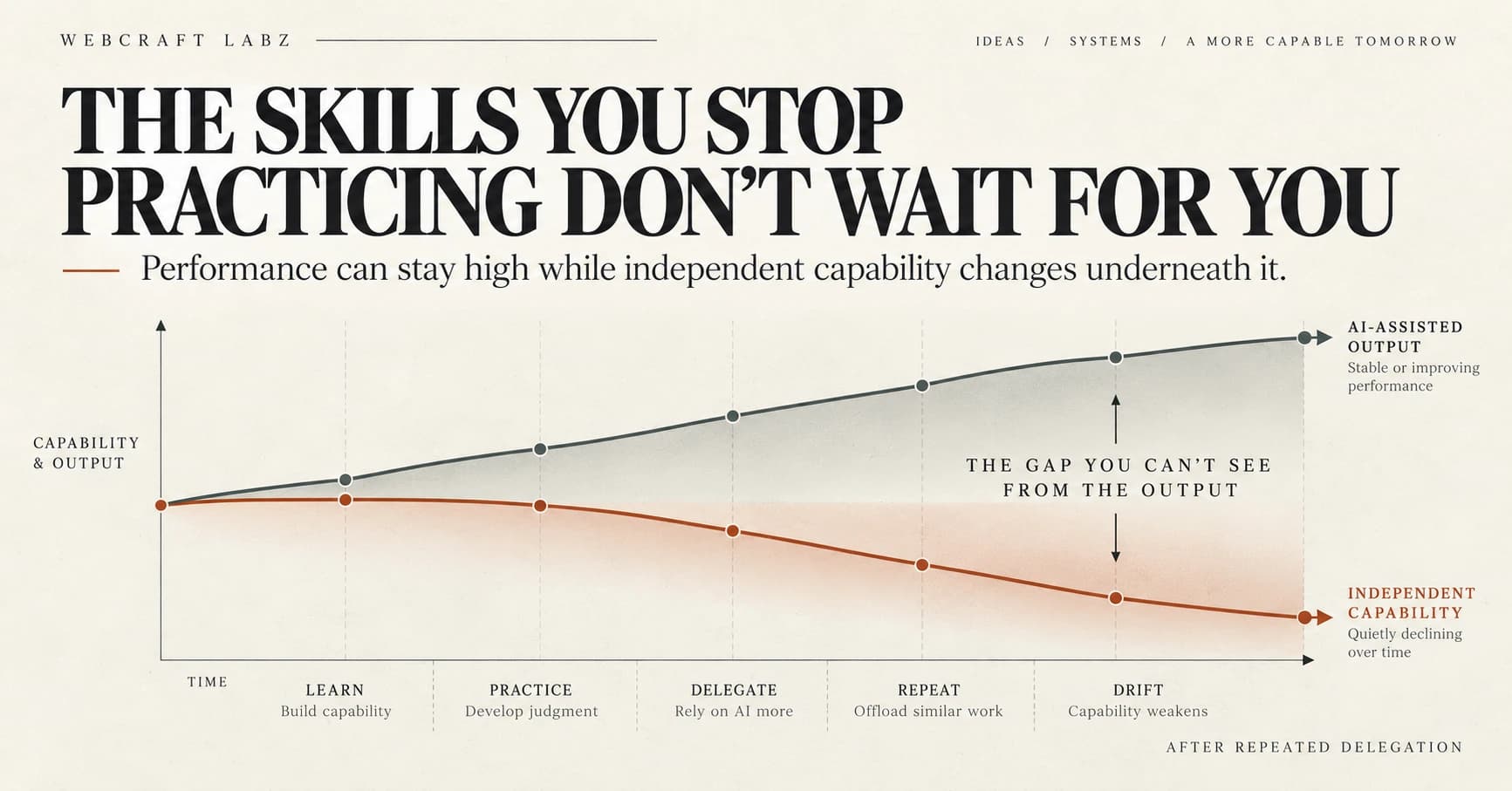
The judgment this essay keeps asking for doesn't arrive on day one. People have always earned it doing beginner's work: debugging code they didn't write, building the reports nobody else wanted to build, grinding through document review. AI is very good at exactly that work.
That is a shortfall against a peer group, not a count of people out of work, and the researchers are explicit that it describes a pattern rather than proving a cause. The comparable figure was 15% in July 2025. The decline shows up as fewer young people hired rather than more people fired, it is concentrated in occupations built on codified knowledge — the formal, documented kind you can learn from textbooks and written procedures — and experienced workers show no comparable gap. The gap narrows when education is accounted for, and the effect is larger in this payroll sample than in national survey benchmarks. It does not disappear.
I dug into that problem in Who Will Train the Humans Who Supervise AI?. Here the point is narrower. If the pipeline of people who learned judgment the hard way is thinning, the businesses that come out ahead won't be the ones waiting for those people to show up. They'll be the ones that make their own systems understandable to the people they already have.
That starts with the person running the business.
PART 07 · The skill
The future business leader doesn't need to be a programmer
None of this means every business owner needs to learn to code. That's less necessary now than it has ever been. What they need is systems literacy.
The second half is the part that matters. Go back to the roofing company and follow that one changed supplier code through the business.
Timeline
01
The data
A supplier changes the code for a shingle line. The estimating agent's lookup stops matching it and falls back to the closest product it can find: tile. Nothing errors out.
02
The estimate
Every shingle bid now carries tile material and labor costs. The quotes come out far above what the jobs should cost, and they look exactly as polished as before.
03
The customer
A homeowner compares three bids. Theirs is the outlier. Nobody calls to ask why. They just pick someone else.
04
The schedule
Fewer signed jobs means open days on the calendar. The scheduling agent fills the gaps with smaller work and reports a well-optimized week, because a lighter calendar isn't an error.
05
The revenue
A month later, the numbers show close rates down by a third. By then, dozens of good leads have gone to competitors.
Every part did its job. The lookup returned a product. The estimate was internally consistent. The scheduler scheduled. The failure only exists at the level of the whole system, which is exactly the level nobody was watching.
Catching it doesn't require reading code. It requires knowing that estimates depend on supplier data, and that a sudden drop in close rates is a pricing question before it's a sales question. That's systems literacy in practice: a tiny technical change, recognized as the business problem it became.
The owner of a twelve-person company in 2030 probably won't write a line of code. But she'll need to know:
- ✓What each system in the business actually does, and what it's allowed to do on its own
- ✓Where the data comes from, where it goes, and who can see it
- ✓What “working correctly” means for each system, in numbers she can check
- ✓What failure would look like, and how she'd find out
- ✓Which decisions she will never hand to a machine, and why
- ✓Who is accountable when something goes wrong, by name
None of that requires a computer science degree. It requires curiosity, skepticism, and the willingness to look under the hood of things that seem to be working fine.
Here's a test any owner can run this week: trace one customer from first contact to paid invoice. A homeowner fills out a form. Where does that information go? Who, or what, decides whether they get a call back, and how fast? Who builds the quote, from what numbers, and who notices if it's wrong? At every step, mark which decisions are automated and where a mistake could sit for weeks without anyone catching it.
Most owners who do this honestly hit at least one "I'm not sure." That's the place to look first.
Within five years, I expect "can you explain how your business's systems work?" to be a routine question from investors, lenders, insurers, and acquirers, the way they ask about the books today. A business that runs on systems its owner doesn't understand carries risk nobody has priced.
PART 08 · Predictions
What I expect to see
Forecasts are only useful if they can be wrong, so here are mine, with rough timelines and how confident I am.
Timeline
By 2028 · High confidence
Verification becomes a line item
Companies budget explicitly for reviewing, testing, and auditing AI-produced work, the way they budget for QA or accounting today.
By 2028 · Medium confidence
Insurers start asking
Business and cyber policies begin asking which decisions are automated and who oversees them. Premiums start to reflect the answer.
By 2030 · Medium confidence
Systems literacy goes mainstream
Business schools, trade associations, and small-business programs teach it as a core management skill, separate from programming.
By 2030 · Medium confidence
The apprenticeship comeback
Structured apprenticeship models show up in software, finance, and law, designed explicitly around learning to catch AI mistakes.
By 2032 · Lower confidence
Named accountability
In regulated industries, it becomes standard to name a specific human owner for every consequential automated system, on paper, the way buildings have an engineer of record.
Wildcard · Unknown timing
The talent cliff hits
Some industries discover a shortage of mid-career experts who can oversee their systems, because the entry-level pipeline thinned out a decade earlier.
I'll revisit this list. Some of it will look obvious in hindsight. Some of it will look naive. That's the point of writing it down.
PART 09 · The conclusion
The new division of labor
Every major shift in technology has redrawn the line between what tools do and what people do. The calculator didn't end mathematics; it moved mathematicians to harder problems. The nail gun didn't end carpentry; it moved the skill from driving nails to knowing where they go.
AI is redrawing that line again: machines produce, people understand. That's not a smaller role for people. It's a harder one, and it was always the most valuable part of the work. We just couldn't see it clearly while everyone was busy making things.
Back to that roofing company in 2031. The business that survives the bad week isn't the one with the fanciest agents. It's the one where somebody looked at a dip in close rates, got suspicious, and knew where to look.
That person may be the most important hire of the next decade. They don't need to be a programmer. We just aren't doing much yet to make sure they exist.
Key takeaways
- Production is getting cheap. Understanding, verification, and accountability are getting scarce.
- The biggest risk isn't systems that crash. It's systems that are plausibly, quietly wrong.
- New roles are emerging around auditing, oversight, and systems design, mostly inside existing jobs rather than as new ones.
- AI is absorbing the entry-level work that has always produced expert judgment. That's a talent problem with a ten-year fuse.
- Business leaders don't need to code. They need systems literacy: knowing what their systems do, how they fail, and who answers for them.
Sources
Build Something Better
Ideas deserve a better home than a generic blog.
WebCraft Labz builds fast, polished websites for businesses and creators who want their ideas to feel premium from the first scroll.
Start a ProjectContinue Reading