
THE EXPERIENCE PARADOX
Who Will Train the Humans Who Supervise AI?
As AI automates entry-level work, who will train tomorrow's experts? Research reveals a growing challenge for apprenticeships and human oversight.
Artificial intelligence is changing how professionals learn their work. Stanford employment research shows a widening early-career gap in AI-exposed occupations, while separate apprenticeship research finds that some employers are increasing training. The deeper concern is whether businesses can preserve the experience needed to supervise increasingly capable AI systems. This analysis examines the future of apprenticeships, human judgment, and the economic incentives behind automation.
Filed under ai, automation, workforce, apprenticeship, human-judgment, future-of-work

Artificial intelligence can now write software, analyze documents, review contracts, and complete work that once occupied the first several years of someone's career.
For businesses, the appeal is obvious. Hours become minutes. Small teams take on work that previously required larger ones. Experienced employees delegate routine assignments and concentrate on more difficult problems.
But there is a question hiding inside those gains.
A young software developer today can ask an AI assistant to generate functions, diagnose errors, and propose solutions, moving through assignments faster than earlier generations could have imagined. Yet knowing why the code works, recognizing when a design is flawed, and predicting what happens when thousands of people begin using an application are different abilities. Those abilities develop through experience.
The same tension is emerging in law, accounting, engineering, journalism, and creative production. In each field, some of the repetitive assignments given to beginners serve another purpose. They expose people to decisions, constraints, mistakes, consequences, and the accumulated knowledge of more experienced professionals.
That matters because many plans for using AI still depend on a human being remaining responsible. Someone reviews the code before it ships. Someone verifies the financial analysis before it reaches a client. Someone approves the contract before anyone signs.
That arrangement only works if the reviewer understands enough to recognize when the system is wrong. And some of the work AI is beginning to absorb is precisely the work through which that understanding was traditionally developed.
Today's experts are still here. The question is where tomorrow's will come from.
The short answer is that the next generation of AI supervisors will need what every generation of experts has needed: mentorship, practical experience, independent problem-solving, and real responsibility for outcomes, now supplemented by AI-assisted learning. The difficulty is that automation may remove many of the entry-level assignments where that development used to happen on its own. If it does, employers and educators will have to build those pathways on purpose.
The early-career gap is widening
In August 2026, researchers Erik Brynjolfsson, Bharat Chandar, and Ruyu Chen at Stanford's Digital Economy Lab published an updated analysis of employment patterns using ADP payroll records covering millions of American workers. They compared workers aged 22 to 25 in highly AI-exposed occupations with workers the same age in less-exposed occupations.
In other words, by June 2026, employment for young workers in the most exposed occupations was about 19% below where it would have been had it kept pace with their less-exposed peers. Three additional findings make that number particularly relevant:
- The adjustment appears primarily in hiring. Companies were hiring fewer young workers in the affected occupations rather than primarily laying off existing employees.
- Experience appears to matter. More experienced workers did not show a comparable shortfall, and some experienced workers in occupations reliant on tacit knowledge saw employment growth.
- The role AI plays matters. Declines were concentrated in occupations where AI tended to automate tasks. Where AI primarily complemented workers, employment was more stable or increased.
The researchers emphasize that these are descriptive findings, not proof that artificial intelligence caused the entire gap. The gap narrows when education is taken into account, and they found no evidence of widespread, economy-wide job displacement.
But the research leaves another question unanswered. If companies increasingly complete junior-level assignments without hiring junior employees, what happens to the professional development those assignments once provided?
A business can operate efficiently for years with experienced staff and increasingly capable software. But workforces are not permanent. People retire, change industries, move into management, or leave their professions altogether. Every industry eventually needs to replace the people who understand how things work.
Historically, one of the most important ways we have done that is by allowing inexperienced people to do the work.
The apprenticeship nobody thought to protect
I've spent roughly 25 years working across electrical, plumbing, carpentry, and repair trades. That experience has made one distinction especially clear to me: knowing the correct procedure and recognizing what is actually wrong are not always the same thing.
Some of the most important warning signs in the trades are surprisingly ordinary. A burnt-plastic or unusual electrical odor can signal overheating before a breaker trips. Discoloration around an electrical device may indicate excessive heat. The pattern of a water stain can help distinguish an old leak from an active one, and the moisture may have traveled some distance from its source. Mineral buildup or corrosion around a plumbing fitting can reveal a small leak nobody has noticed.
None of those replace proper testing. They are clues. And someone can know the correct installation procedure perfectly well and still walk past every one of them.
Reading those clues comes from time on real jobs. From seeing how systems behave. From investigating problems that initially made little sense. From encountering the consequences of decisions that looked reasonable when they were made. The difference is not access to information. It is judgment developed through repeated encounters with reality.
Desk jobs develop expertise in much the same way. A junior attorney may begin recognizing ambiguous contract language after examining hundreds of clauses. A young developer who spends days investigating a difficult bug may learn something about system design that influences decisions years later. An assistant editor might discover that removing a few seconds from a scene changes its emotional meaning. An accountant may learn to spot a suspicious pattern in records that initially looks perfectly ordinary.
None of these experiences necessarily feels important while it is happening. Some of the work is tedious. Much of it is precisely what organizations would prefer to automate. But the work has two outcomes.
A completed task and a more experienced human being.
Figure 01
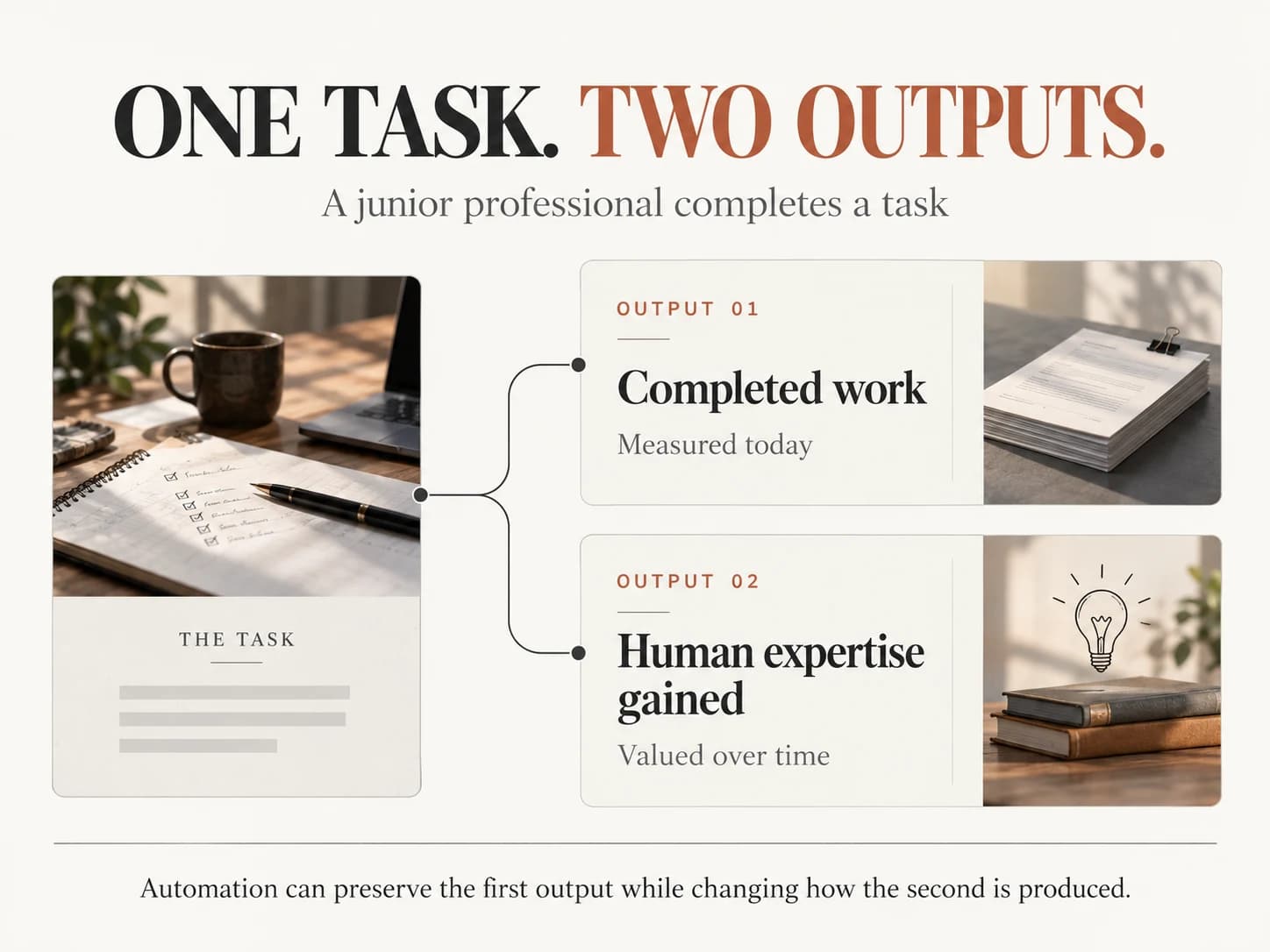
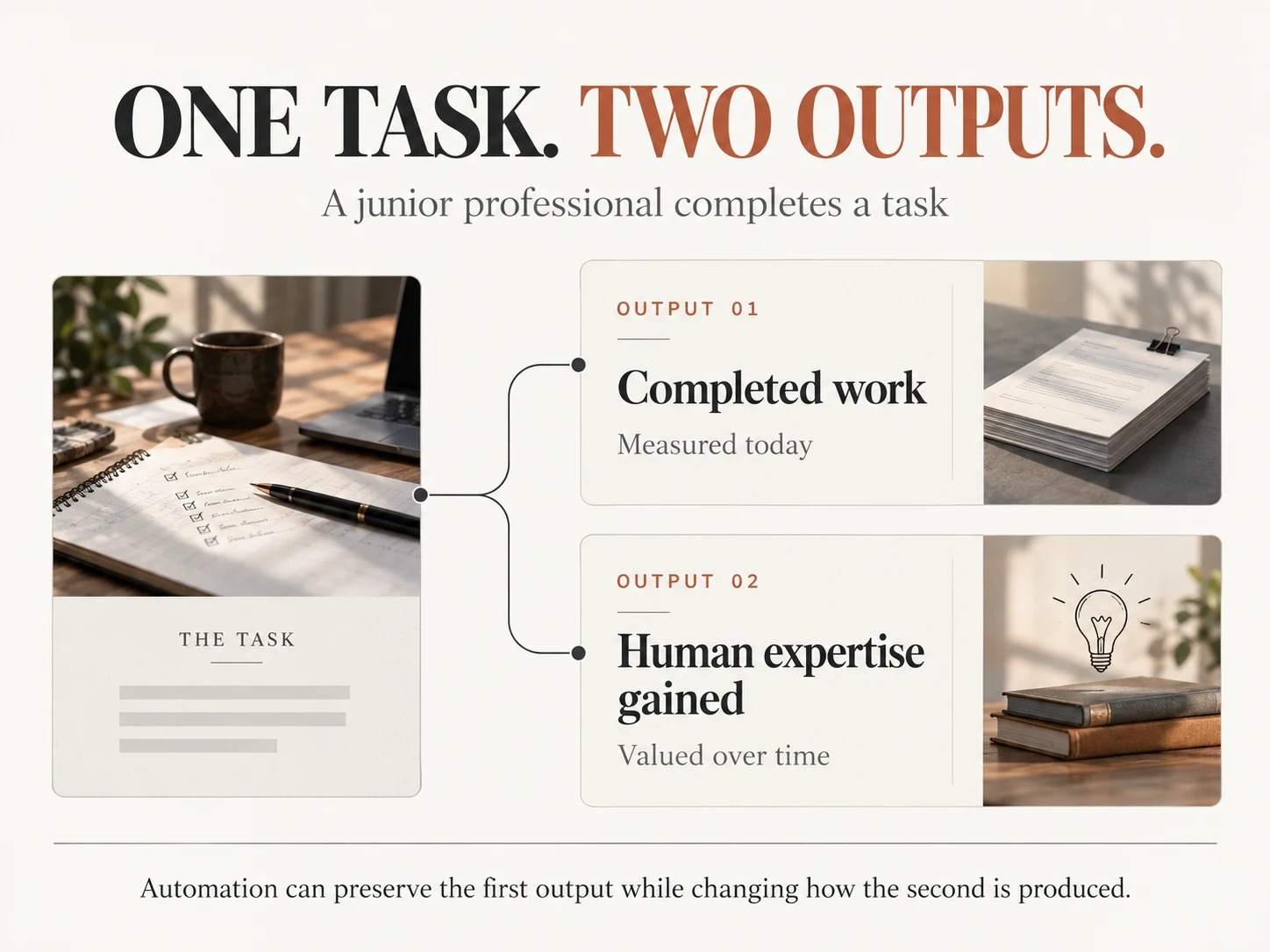
Productivity measurements tend to focus on the first. The second is considerably harder to quantify. That creates a possibility businesses may not be accounting for: an organization could become more efficient at producing work while becoming less effective at developing the people capable of understanding it.
We explored the individual version of this problem in Capability Debt: The Skills You Stop Practicing Don't Wait for You. The concern here is broader: what happens when entire industries lose some of their traditional paths to expertise?
We've encountered this problem before
The relationship between automation and human expertise is not a new concern.
In 1983, psychologist and engineer Lisanne Bainbridge published a paper in Automatica titled Ironies of Automation. She examined what happens when automated industrial systems handle routine operations while humans remain responsible for supervision and intervention.
One of the central ironies was that automation could reduce opportunities for operators to practice the very abilities they would need during abnormal conditions. Machines handled ordinary operations. Humans were expected to respond when something unusual happened, and those unusual situations were often the ones demanding the greatest understanding.
The difficulty wasn't that the automation failed. It was that successful automation changed what the remaining human operator was expected to do.
More than four decades later, generative AI is bringing a version of this problem into professions built around knowledge, interpretation, and creative decisions. Instead of supervising industrial machinery, people now supervise AI-generated software, financial analysis, technical documentation, legal work, and increasingly complex business processes. The responsibility shifts from producing the original work to deciding whether that work can be trusted.
That can be a more valuable role. It can also be a more demanding one. Reviewing something you didn't build is not necessarily easier than building it yourself.
Why does AI still need experienced supervisors?
Picture two developers reviewing the same AI-generated code.
Experienced developer
- Fifteen years designing applications
- Has diagnosed real production failures
- Maintained software long after its original authors moved on
AI-first developer
- Career spent largely with AI-generated implementations
- Reads and modifies generated code fluently
- Has rarely built or maintained a system end to end
Both can read the code. Both can identify obvious mistakes. Both understand what the application is supposed to do. But the experienced developer may recognize deeper problems: a database design that will become difficult to maintain, an authentication boundary that introduces unnecessary risk, a convenient dependency that will complicate future development, an architecture that works today but becomes expensive as the application grows.
That understanding often comes from having encountered similar problems before. As we explored in The Future of Software Development With AI, making code easier to generate does not eliminate the need for verification, integration, maintenance, and technical judgment.
Now imagine a company decides AI can generate so much software that it no longer needs as many junior developers. It retains experienced engineers to supervise the output. Labor costs fall, production increases, and for the moment the decision looks reasonable.
But eventually those senior employees leave. Will the next generation have developed an equivalent depth of understanding?
Possibly. AI-assisted development may create new paths to expertise. But reviewing and modifying generated output does not guarantee the same learning as designing, building, troubleshooting, and maintaining systems independently.
Supervision is a skill in its own right. It requires understanding the assumptions beneath a recommendation, recognizing dependencies, evaluating tradeoffs, and knowing when apparently convincing work is fundamentally unsound. A confident explanation from an AI system does not remove the need for those abilities, and adding a human approval step to the end of an automated process does not automatically establish meaningful oversight.
Creative industries face the same question
Filmmaking offers a particularly revealing example.
Generative video is making it possible for individuals to produce imagery that once required significant equipment, specialized labor, and production budgets. For independent creators without access to cameras, studios, sets, or visual-effects teams, that is a real opportunity.
But cinematographers, editors, directors, and production designers have traditionally developed their abilities on real productions. They watch experienced colleagues make decisions. They see how a lighting change affects a performance, how a cut alters the emotional weight of a scene, how constraints shape storytelling, how an unexpected problem forces a creative solution. Those lessons are not contained in the finished film. They happen while making it.
If synthetic production reduces substantial amounts of entry-level production work, the industry will need new ways to provide those experiences. AI may dramatically expand the number of people who can generate convincing moving images. Whether it also expands the number capable of directing compelling films will depend partly on how the craft is taught.
If technology makes the tools of a profession accessible to everyone, who will teach the judgment required to use them well?
Can AI replace traditional apprenticeships?
There is a serious counterargument to concerns about disappearing apprenticeships: AI could become an extraordinary educational resource.
A young developer can request an explanation of unfamiliar code at two in the morning. A student can practice a difficult problem repeatedly, compare approaches, and get immediate feedback. A trainee without experienced mentors may gain an interactive learning resource previous generations never had. AI could make professional education more accessible, more personalized, and less dependent on geography or institutional resources.
And some research challenges the assumption that AI adoption necessarily reduces training.
A study by Samuel Muehlemann, published in the Journal of Economic Behavior & Organization in October 2025, examined AI adoption and workplace training among German firms. Using establishment-level data from 2019 through 2023, it found that sustained AI adoption was associated with a 14% increase in new apprenticeships among firms already offering apprenticeship training. It did not find a significant relationship between AI adoption and a firm's decision to offer apprenticeships in the first place. It also found that continuing training resources increasingly shifted toward higher-skilled employees.
That is more complicated than a straightforward decline in training. Some companies are responding to AI by expanding opportunities for beginners, while directing more advanced training toward workers who already have substantial skills. Germany's established apprenticeship system may also help firms there adapt training to new technology. The broader outcome remains uncertain.
But there is a distinction worth preserving: an explanation is not the same as experience.
An AI tutor can explain how to diagnose an electrical fault. A simulation can teach someone how to approach an unfamiliar condition safely. Neither is the same as working a real installation under supervision. A coding assistant can explain why an architecture might fail, but maintaining the system when a real failure occurs develops a different kind of understanding.
So the question is not whether to choose traditional apprenticeship or AI-assisted education. It is which experiences can be replaced, which can be improved, and which remain essential to developing independent professional judgment.
How can companies develop expertise while automating work?
For generations, much professional learning was embedded in ordinary production. Junior employees handled manageable assignments, received feedback, made mistakes, corrected them, and gradually took on more responsibility. The organization received useful labor. The employee gained experience.
Automation can separate those two outcomes.
A company may no longer need a junior analyst to prepare the first draft of a report. But it may still need future professionals who can research, verify, interpret, and defend the conclusions. If those abilities remain valuable, organizations cannot assume they will develop automatically. Training has to become an explicit responsibility rather than a side effect of employment, and the skills worth building, the ones covered in The Human Skills That Matter More in an AI World, have to be practiced somewhere.
Building expertise in an automated world
- Solve first, compare second. Trainees work a problem independently before seeing the AI-generated solution.
- Train on failure. Build simulations around broken systems, contradictory evidence, unexpected failures, and missing information.
- Protect mentorship even when automation could finish the immediate assignment faster.
- Build small before supervising big. Developers design, test, and maintain small applications before supervising AI agents across large repositories. Accountants trace transactions through records before approving automated reconciliations.
- Keep the craft in the curriculum. Filmmakers study composition, performance, editing, and visual storytelling while using generative tools to experiment.
The objective is not to preserve inefficient work indefinitely. It is to recognize that some work matters because of what it teaches the person doing it, not only because of what it produces.
What happens when companies stop hiring junior workers?
This is where the problem moves beyond technology and becomes a question of economic incentives.
Imagine a software company that traditionally employs one senior engineer and five junior developers. As AI absorbs more routine programming work, it decides it can operate with fewer juniors. Its costs decline immediately. It delivers faster and becomes more competitive. Other companies make similar decisions, and from each one's perspective, the choice is entirely rational.
Now imagine those companies ten years later. They still need experienced engineers: people capable of reviewing complex systems, investigating failures, evaluating security risks, and taking responsibility for decisions automated systems cannot safely make alone. But if few companies spent the intervening decade developing junior talent, where will those professionals come from?
That is the economic paradox. The financial benefits of cutting training-intensive work arrive immediately and belong to the businesses making those decisions. The costs of a weakened talent pipeline arrive later and are shared across an industry. Other employers struggle to recruit. New entrants find fewer places to build their skills. Clients become dependent on a shrinking pool of specialists.
No individual company intends that outcome. Yet collectively, businesses could underinvest in a resource they all expect to remain available. It's the gap between a company getting faster and a company getting smarter, a distinction we examined in Is Your Company Getting Smarter, or Just Faster?.
Somebody has to produce the expertise everyone wants to buy. And the problem gets harder when the work being automated is the same work that once helped produce it.
The review bottleneck
Automation does not necessarily eliminate the need for expertise. In some cases, it concentrates responsibility in fewer people.
As AI handles larger portions of production work, experienced professionals are expected to evaluate increasingly complex output, investigate unusual failures, and make decisions that require substantial judgment. Those responsibilities demand expertise. But if organizations reduce the opportunities through which juniors develop it, they could eventually face a shortage of qualified reviewers, even as the volume of AI-generated code, analysis, and documentation keeps rising.
That creates two possible problems. Output may accumulate faster than qualified professionals can review it, which is a productivity bottleneck. Or organizations may let less-qualified reviewers approve work they don't fully understand, which is a problem of trust and accountability.
Figure 02
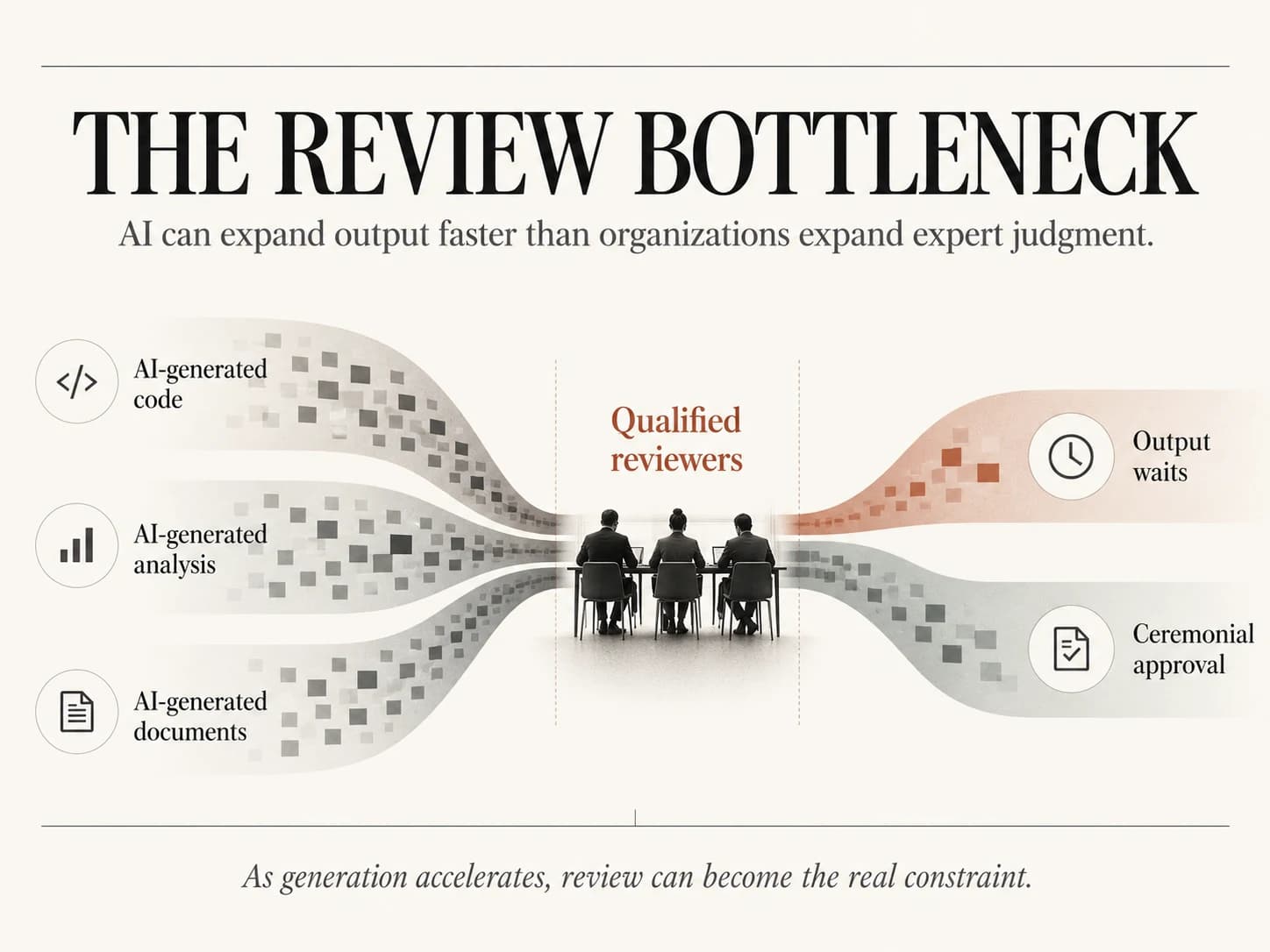
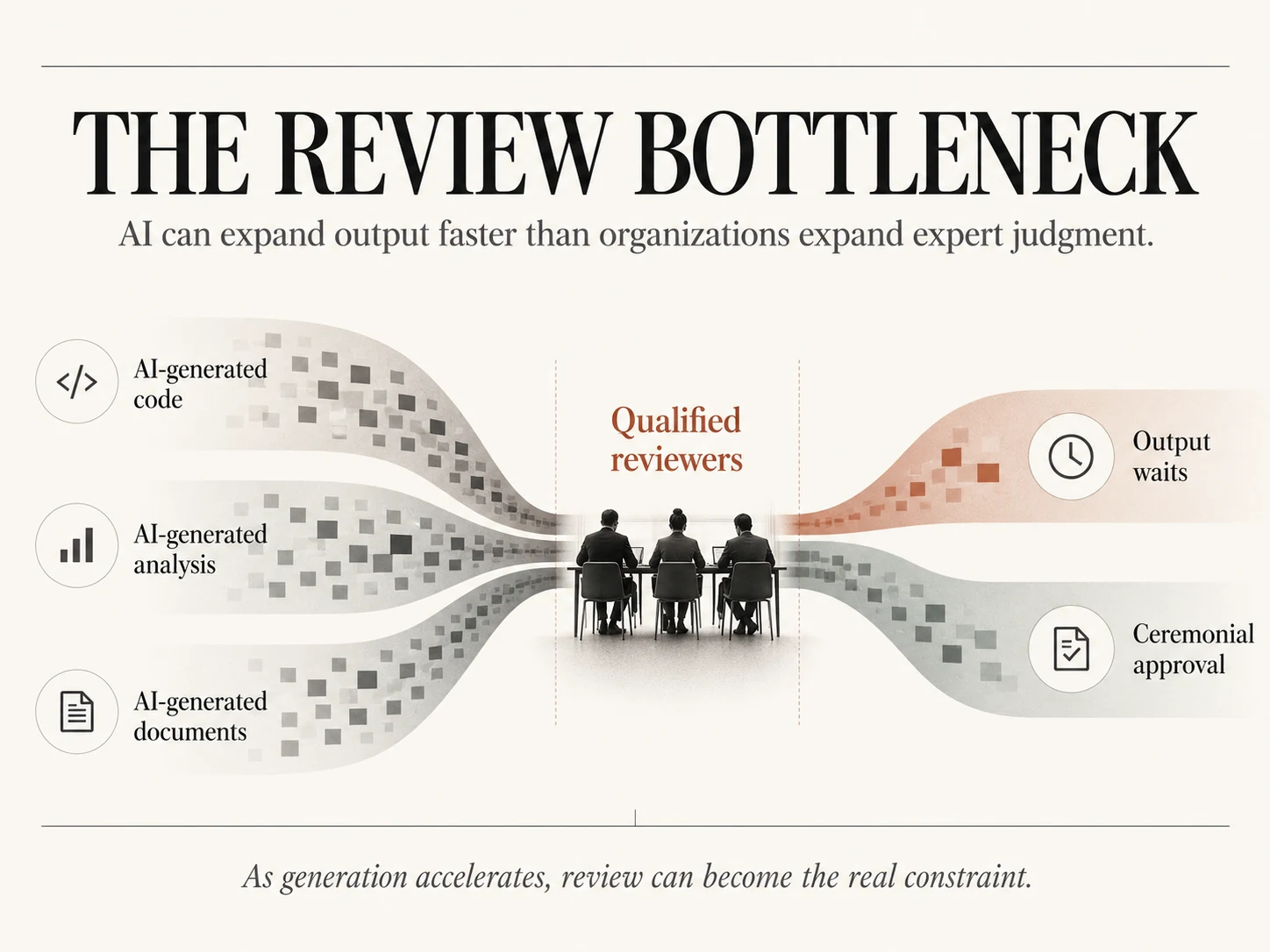
This is a different bottleneck from the one described in Enterprise AI Is Creating a Human Bottleneck. That piece looks at operational friction: approval processes, fragmented information, and unclear ownership. The bottleneck here is an expertise bottleneck. Even with perfect processes, an organization can only review what it has people qualified to understand.
Neither outcome is inevitable. AI may also improve verification, testing, and professional education, and new forms of supervision may emerge that require different skills from those valued today. The New Business Skill Is Understanding Systems sets out what those skills look like and who ends up accountable for them. But those possibilities don't remove the responsibility to decide what human expertise future systems will require and how it will be developed.
An organization can measure the time an AI assistant saves reviewing contracts. It is much harder to calculate the judgment a junior attorney might have developed reviewing those contracts for years. That value rarely appears in a productivity dashboard, and what cannot be measured easily is especially easy to overlook.
The investment we aren't making
The familiar debate about artificial intelligence asks whether machines will replace human workers. It is an important question, but it may be obscuring another one: what happens to the process of becoming a skilled professional when machines increasingly perform the work through which that skill has traditionally developed?
The first generation of people supervising advanced AI learned much of their craft in a world where humans did most of the work. They wrote the code, examined the contracts, investigated the failures, assembled the equipment, and made the difficult decisions. Their experience was built through years of direct participation.
The next generation may enter a professional world where many of those activities are assisted, transformed, or performed by intelligent systems. That does not mean they cannot become better engineers, filmmakers, physicians, attorneys, or builders. They may develop capabilities previous generations could scarcely imagine.
But we cannot assume the traditional process of developing expertise will survive unchanged. Nor can we assume that access to increasingly sophisticated AI automatically produces the judgment required to supervise it.
Industry, education, and government may all have roles to play. Employers in particular will need to decide whether developing human expertise remains part of their responsibility, even when automating the work looks more economical in the short term. Automation can change how work gets done. It cannot, by itself, settle how a society develops the people responsible for that work.
We are investing enormous resources in teaching machines to perform tasks that once took humans years to master.
The harder investment may be ensuring there are still humans who understand what that work requires.
Research and sources
-
Erik Brynjolfsson, Bharat Chandar, and Ruyu Chen. Canaries in the Coal Mine? Six Facts about the Recent Employment Effects of Artificial Intelligence. Stanford Digital Economy Lab, revised August 2026. Uses ADP payroll data through June 2026. The reported employment differences are descriptive, not definitive causal estimates.
-
Lisanne Bainbridge. Ironies of Automation. Automatica, Volume 19, Issue 6, November 1983, pp. 775–779. Foundational discussion of the challenges of maintaining effective human supervision as industrial processes become automated.
-
Samuel Muehlemann. Artificial Intelligence Adoption and Workplace Training. Journal of Economic Behavior & Organization, Volume 238, October 2025. Uses German establishment-level data to examine changes in apprenticeship and continuing-training activity associated with AI adoption.