The Human Skills That Matter More in an AI World
AI does not eliminate the need for human skill. It changes where human skill matters most. A practical guide to the seven abilities that decide whether intelligent tools produce something useful, forgettable, or harmful.

Artificial intelligence can write the email.
Build the presentation.
Summarize the meeting.
Generate the image.
Analyze the spreadsheet.
Draft the strategy.
And, given the right tools, complete several of those steps before you finish your coffee.
That naturally creates an uncomfortable question:
What is left for us?
It is the wrong question.
The more useful question is:
Which human abilities become more valuable when producing the first version of almost anything becomes easy?
AI does not eliminate the need for human skill. It changes where human skill matters most.
When producing words was difficult, being able to produce words was valuable. When information was scarce, knowing where to find it was valuable. When building software required years of technical training, writing the code was often the largest barrier between an idea and a working product.
Those barriers have not disappeared, but they are moving.
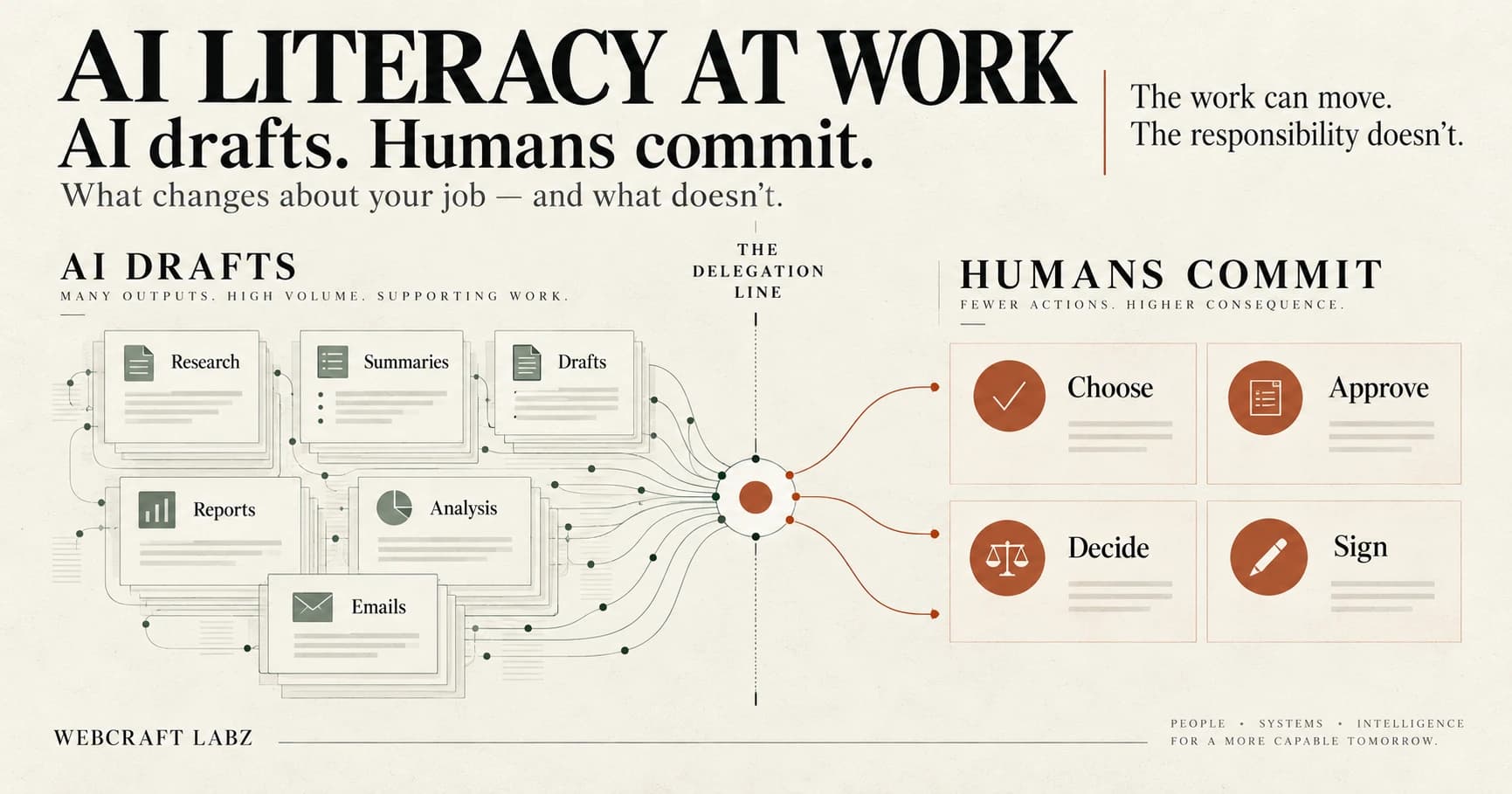
AI can now generate more options, drafts, ideas, explanations, designs, and recommendations than any one person could reasonably evaluate.
That means the bottleneck is no longer always production.
Increasingly, the bottleneck is direction.
Knowing what to ask.
Recognizing what is good.
Noticing what is missing.
Understanding the situation.
Choosing between plausible answers.
Explaining the decision.
And accepting responsibility for what happens next.
These are not consolation prizes left behind after machines take the "important" work.
They are the abilities that determine whether intelligent tools produce something useful, something forgettable, or something actively harmful.
This guide assumes you already have a working picture of what AI is and how it behaves. If you don't, or if you'd like to firm it up first, AI 101: A Beginner's Guide to Artificial Intelligence covers the fundamentals — what these systems are actually doing, why they get things wrong, and how to prompt them well.
AI Changes the Value of Skills
Technology rarely makes every human ability less valuable at once.
It usually makes some abilities cheaper while increasing the value of others.
Calculators reduced the need to perform arithmetic by hand. They did not remove the need to understand which numbers mattered.
Search engines made information easier to find. They made the ability to judge sources more important.
Digital cameras made taking photographs nearly free. They did not make composition, timing, perspective, or taste irrelevant.
AI follows the same pattern, only across a much wider range of work.
It lowers the cost of producing an answer.
That raises the value of knowing whether the answer is any good.
It lowers the cost of creating options.
That raises the value of choosing between them.
It lowers the cost of getting started.
That raises the value of knowing where you are going.
The people who benefit most from AI will not necessarily be the people who use it for everything. They will be the people who understand where it helps, where it weakens the work, and where a human decision still carries the weight.
That begins with judgment.
SKILL 01 · Weighing information against reality
Judgment
AI is exceptionally good at producing plausible options.
That is not the same as knowing which option is right.
Imagine asking an AI to create three marketing strategies for a small business. All three might be clearly written. Each might contain reasonable ideas. None may have obvious errors.
But one assumes the company has more money than it does.
Another depends on a customer behavior that does not exist in that market.
The third fits the budget, the audience, the owner's personality, and the actual way customers make decisions.
Choosing the third option requires more than language generation.
It requires judgment.
Judgment is the ability to weigh information against reality. It draws from experience, context, priorities, consequences, and an understanding of what matters in this particular situation.
AI can help compare the options. It can identify tradeoffs. It can challenge assumptions and point out risks.
But it does not carry the consequences of the decision.
You do.
That distinction matters.
A recommendation can sound intelligent while being completely wrong for the person, organization, or moment receiving it. The best answer on paper may be the worst answer in context.
Judgment notices the difference.
How AI Can Weaken It
The danger is not simply that AI sometimes produces incorrect information.
The deeper danger is that polished answers can make evaluation feel unnecessary.
When something arrives clearly formatted, confidently explained, and ready to use, accepting it becomes easier than examining it.
Convenience can quietly become compliance.
You stop asking why.
You stop comparing alternatives.
You stop noticing which assumptions entered the answer without permission.
Eventually, you may become faster at producing decisions while becoming worse at making them.
How to Strengthen It
Do not ask AI only for an answer. Ask it to expose the decision.
Try questions such as:
What assumptions are you making?
What would make this recommendation fail?
Give me the strongest alternative.
Who might disagree with this, and why?
Which part of this answer depends most heavily on missing information?
What would change your recommendation?
Then make the final choice yourself.
Try This
The next time AI gives you a recommendation, do not immediately ask it to improve the answer.
First, write down:
- What seems right
- What seems questionable
- What information is missing
- What consequence the AI does not have to live with
Then continue the conversation.
That small pause turns AI from an authority into what it should be: an instrument for better thinking.
SKILL 02 · Defining the problem before solving it
Question Framing
AI can answer an extraordinary number of questions.
It cannot guarantee that you are asking the right one.
A struggling company might ask:
How can we generate more leads?
But perhaps leads are not the real problem.
Maybe people are visiting the website and leaving because the offer is unclear.
Maybe inquiries arrive but nobody follows up quickly.
Maybe customers buy once and never return.
Maybe the company is attracting exactly the wrong type of customer.
More answers about lead generation will not solve a problem caused by poor conversion, weak follow-up, low retention, or bad positioning.
A perfectly answered question can still send you in the wrong direction.
Question framing is the ability to define the actual problem before rushing toward a solution.
It means separating symptoms from causes.
It means noticing when the obvious question contains a hidden assumption.
It means asking whether the problem you are solving is the problem that matters.
This skill becomes more valuable in an AI world because AI makes it incredibly easy to move quickly.
And speed in the wrong direction is still wrong.
How AI Can Weaken It
AI rewards immediacy.
You type a question and receive an answer before you have fully examined what you asked.
That can create the illusion of progress.
Documents appear.
Plans take shape.
Tasks get organized.
But activity is not the same as understanding.
If the original question is poorly framed, AI can help you build an impressively detailed solution to the wrong problem.
How to Strengthen It
Before asking for solutions, ask AI to help investigate the question.
Instead of:
How do I improve employee productivity?
Try:
Before suggesting solutions, help me determine what "low productivity" means in this situation. Ask me one question at a time about workload, tools, expectations, communication, incentives, and how performance is being measured.
Instead of:
Build features for my app.
Try:
Help me identify the three most important user problems. Do not propose features until we agree on the problems.
The goal is not to make every prompt longer.
It is to spend more time understanding the assignment before generating the deliverable.
Try This
Take a problem you are currently trying to solve and write down your first question.
Then challenge it:
- What am I assuming?
- Is this the cause or only the symptom?
- Who experiences the problem differently?
- What would I need to know before choosing a solution?
- Is there a better question underneath this one?
A powerful question does more than produce a better AI response.
It changes what becomes possible to see.
SKILL 03 · Recognizing what deserves to exist
Taste
AI can generate twenty logos before lunch.
It can draft ten headlines in seconds.
It can create five layouts, three color palettes, four introductions, and an entire page of alternatives without becoming tired, defensive, or emotionally attached to any of them.
What it cannot do for you is decide what you want to stand behind.
That is taste.
Taste is often mistaken for personal preference — as though it means liking blue more than green or minimalism more than decoration.
Real taste is more demanding.
It is the ability to recognize quality, coherence, originality, appropriateness, and emotional truth.
It knows when something is technically correct but lifeless.
It notices when a sentence sounds polished but says nothing.
It recognizes when a design is attractive but belongs to the wrong brand.
It can feel the difference between something inspired by familiar work and something that merely imitates it.
As AI makes competent production easier, average-looking work will become abundant.
Clean layouts will be everywhere.
Grammatically correct writing will be everywhere.
Reasonable ideas will be everywhere.
That makes distinction more valuable.
Not decoration for the sake of being different.
Not forced originality.
The ability to recognize what feels honest, necessary, and specific — and remove everything that does not.
How AI Can Weaken It
If you repeatedly accept the first polished result, your work can begin drifting toward the statistical middle.
AI is trained on patterns. It is naturally comfortable producing things that resemble what already exists.
That makes it useful.
It also makes generic competence dangerously easy.
Without active direction, different brands begin sounding alike. Articles repeat the same conclusions. Websites inherit the same structure. Images share the same artificial gloss.
Nothing is obviously broken.
Nothing is memorable either.
How to Strengthen It
Taste is built through attention.
Study work you admire and ask why it works.
Compare strong examples with weak ones.
Describe the difference without relying on words like "better," "cleaner," or "more professional."
Collect references.
Notice details.
Develop opinions.
Then test those opinions against real audiences and real outcomes.
AI can help with this process, but it should not perform the act of choosing for you.
Ask it:
Give me five directions that are meaningfully different, not minor variations.
Explain what feels generic about this draft.
Which parts resemble common industry language?
Remove anything that could appear on a competitor's website unchanged.
Compare these options, but do not choose for me.
Then decide what belongs.
Try This
Generate three versions of something: a headline, image concept, product description, email, or page introduction.
Do not ask AI which one is best.
Choose one yourself and explain:
- What it communicates
- What it avoids
- Why it fits the audience
- What feels distinctive
- What still needs improvement
Then ask AI to challenge your reasoning.
Taste grows when you practice choosing — and understand why you chose.
SKILL 04 · Knowing when confidence has been earned
Verification
AI can make research feel finished long before it actually is.
An answer arrives with dates, statistics, quotations, studies, and links. The language sounds certain. The structure looks professional. Everything appears complete.
Then you check the source.
The quotation does not exist.
The study says something different.
The statistic came from a page citing another page that cites another page, and nobody seems to know where the number began.
The answer was not necessarily designed to deceive you. It was designed to generate a convincing response based on the information and patterns available to it.
It also matters in ordinary life.
AI can help you compare products, understand a repair, research a purchase, plan a trip, or evaluate a business idea. But the more specific and consequential the claim, the less you should rely on presentation alone.
How AI Can Weaken It
AI reduces the friction that once reminded us research was unfinished.
A messy pile of browser tabs looks like work in progress.
A polished summary looks complete.
That appearance can cause us to stop one step too early.
There is also a subtler problem: AI can give us an answer we already want to believe. When a response supports our assumptions, we become less motivated to inspect it closely.
The result is not just misinformation.
It is outsourced certainty.
How to Strengthen It
Separate generating an answer from proving it.
Ask:
Which claims in this response require verification?
What is the original source for this number?
Is this a primary source or someone else's summary?
What evidence would contradict this conclusion?
Which parts of your response are facts, interpretations, or assumptions?
When accuracy matters, open the source yourself.
Confirm that it exists.
Check the date.
Read enough context to understand what it actually says.
Look for independent confirmation.
And remember that a list of citations is not the same as evidence. A source only helps if it genuinely supports the claim attached to it.
Try This
Take one AI-generated answer containing at least three factual claims.
For each claim, mark it as:
- Verified
- Plausible but unconfirmed
- Opinion or interpretation
- Incorrect or misleading
Then correct the answer before using it.
Verification is not distrust for its own sake.
It is the discipline of knowing when confidence has been earned.
SKILL 05 · Turning fragments into understanding
Synthesis
Information is abundant.
Understanding is not.
AI can summarize ten documents, extract recurring themes, compare arguments, and organize hundreds of pages into a clean report.
But synthesis is more than compression.
It finds relationships between ideas that arrived separately.
It notices that two sources are describing the same problem from different angles.
It recognizes that a customer complaint, a declining metric, and an internal workflow failure may all share one cause.
It turns fragments into a model of what is happening.
That requires context.
Not merely the context inside a prompt, but the context accumulated through experience: what happened before, what people are not saying, which constraint is real, and which detail changes the meaning of everything around it.
AI can assist with this work tremendously.
It can hold more material in view than most people can at once. It can categorize, compare, challenge, and reorganize.
But someone still has to decide which connections matter.
How AI Can Weaken It
When summaries are effortless, we can begin consuming conclusions without building understanding.
We know what each document says, but not how the ideas relate.
We collect highlights without developing a point of view.
We mistake organized information for insight.
Synthesis requires spending enough time with the material to form a mental structure of your own. If AI always performs that step before you engage with the source, your understanding may remain dependent on the tool's framing.
You receive the map without learning the terrain.
How to Strengthen It
Use AI after forming an initial interpretation, not always before.
Read the important material.
Write down what you think it means.
Identify the relationships you notice.
Then use AI to test your structure:
What connections have I missed?
Which of these ideas are actually in tension?
What evidence does not fit my explanation?
Organize this material three different ways.
What conclusion would someone with a different perspective draw?
The goal is not to protect your first interpretation.
It is to develop one strong enough to survive contact with alternatives.
Try This
Choose three articles, reports, customer comments, or pieces of information about the same subject.
Write one sentence describing each.
Then write a fourth sentence explaining what becomes visible only when all three are considered together.
That fourth sentence is where synthesis begins.
SKILL 06 · Helping meaning travel between people
Communication
AI can make almost any sentence sound professional.
That may be one of its least interesting abilities.
Good communication is not the act of making language smoother. It is the work of helping another person understand what matters.
That requires knowing:
- Who they are
- What they already understand
- What they need from you
- What they may resist
- What could confuse them
- What should happen after they finish reading or listening
The same information may need to become a technical document, a client email, a five-minute explanation, a sales page, a warning, or a conversation.
AI can transform the format.
Human communication decides what the moment requires.
A perfectly written message can still fail because it arrived at the wrong time, used the wrong tone, buried the important point, or answered a question nobody was asking.
How AI Can Weaken It
AI makes it easy to generate language without fully deciding what you mean.
You can create a long email before identifying the one sentence the recipient actually needs.
You can polish away your natural voice.
You can replace a difficult conversation with a carefully worded message that avoids the real issue.
And because the writing sounds competent, you may not notice that it lacks conviction, specificity, or a recognizable human being behind it.
More communication does not automatically create more understanding.
Sometimes it simply creates more text.
How to Strengthen It
Decide the purpose before drafting.
Ask yourself:
- What does this person need to understand?
- What do I want them to feel?
- What decision or action should follow?
- What am I avoiding saying directly?
- What can be removed?
Then use AI to refine the delivery.
You might ask:
Identify the main point of this message.
What could the reader misunderstand?
Make this clearer without removing my voice.
Show me where I sound vague or evasive.
Cut anything that does not help the recipient make the decision.
AI should help your meaning travel.
It should not manufacture meaning you never established.
Try This
Before writing your next important message, express its purpose in one sentence:
After reading this, the person should understand ______ and be able to ______.
Write the message only after you can complete that sentence.
Then use AI to test whether the finished draft delivers what you intended.
Communication improves when clarity begins before the first word.
SKILL 07 · Owning what happens next
Accountability
There is one sentence AI cannot truthfully say:
I accept responsibility for what happens next.
It can recommend.
Predict.
Warn.
Generate.
Analyze.
It can even explain why one decision appears stronger than another.
But it does not lose the customer.
Face the employee.
Repair the damage.
Defend the decision.
Or live with the consequences.
Accountability is the willingness to own the result of a choice, including choices made with AI assistance.
This may be the most important human skill in the entire system because it prevents every other decision from disappearing into the machine.
"The AI suggested it" is an explanation of process.
It is not an excuse.
How AI Can Weaken It
Automated systems can make responsibility difficult to locate.
A person follows the recommendation.
A manager trusts the system.
The system relies on data selected by someone else.
When the result goes wrong, everyone can point one step backward.
Eventually, a consequential decision appears to have happened without anybody actually making it.
That is dangerous.
The more autonomy we give intelligent systems, the more clearly humans must define who remains responsible for their instructions, boundaries, review, and results.
How to Strengthen It
Before using AI in an important decision, establish ownership.
Ask:
- Who verifies the information?
- Who makes the final decision?
- Who could be affected?
- Who can stop the process?
- Who explains the outcome?
- Who is responsible if the recommendation is wrong?
If nobody can answer those questions, the system is not ready for the responsibility it has been given.
Accountability also means being willing to reject an efficient answer when it violates a value, harms someone unfairly, or creates a consequence the system cannot understand.
These Skills Work Together
The seven skills in this guide are not separate settings you turn on one at a time.
They form a chain.
Question framing identifies the real problem.
Judgment determines what matters.
Taste recognizes which direction feels coherent and worthwhile.
Verification checks whether the work can be trusted.
Synthesis connects the available information.
Communication makes the decision understandable.
Accountability ensures someone owns what happens next.
Weakness anywhere in that chain affects everything after it.
A beautifully communicated answer built on an unverified claim is still unreliable.
A verified conclusion aimed at the wrong problem is still wasted effort.
A tasteful solution nobody can explain or defend will struggle to survive.
AI can strengthen every link.
It can also accelerate every weakness.
That is why becoming "good at AI" involves more than learning prompt techniques or keeping up with the newest model.
The quality of the result still depends heavily on what that person notices, questions, understands, chooses, and accepts responsibility for.
The WebCraft Labz Human Skills Practice
You do not build these abilities by avoiding AI.
You build them by refusing to become passive while using it.
Try this five-step practice with one real task each week.
Step 1: Frame Before You Prompt
Write down the problem in your own words.
Then ask what assumptions are hiding inside it.
Do not request a solution until you can explain what you are actually trying to change.
Step 2: Generate More Than One Direction
Ask AI for several meaningfully different approaches.
Do not allow five versions of the same idea to impersonate variety.
Step 3: Choose Before Asking AI to Choose
Select the strongest direction yourself.
Explain why it fits the audience, goal, constraints, and moment.
Then ask AI to challenge your decision.
Step 4: Verify What Matters
Identify the claims, numbers, quotations, technical details, or assumptions that could change the result.
Confirm them using reliable sources or direct evidence.
Step 5: Own the Final Version
Edit the work until you can explain and defend every important choice.
Remove anything you would blame on the AI if questioned later.
If your name, company, or reputation is attached to the result, the result is yours.
This practice takes longer than copying the first response.
That is the point.
AI should reduce unnecessary effort.
It should not remove the thinking that gives the work value.
You Do Not Need to Compete With the Machine
People sometimes talk about the future as though humans and AI are applying for the same position.
Who writes faster?
Who remembers more?
Who analyzes more data?
Who generates more options?
On those terms, the machine will keep improving.
But speed and volume are not the full measure of useful work.
The purpose of intelligence is not merely to produce more.
It is to understand what deserves attention.
To recognize consequences.
To make choices under uncertainty.
To communicate across differences.
To care about the outcome.
The goal is not to prove that AI can never perform parts of these skills. It already can assist with all of them, and its abilities will continue to grow.
The point is that tools do not relieve people of the responsibility to develop them.
An AI system can help evaluate evidence.
Someone still decides what standard of evidence is enough.
It can generate a thousand possibilities.
Someone still chooses which possibility becomes real.
It can help write the message.
Someone still has to mean it.
It can recommend the action.
Someone still has to answer for it.
What Becomes More Human
AI will continue making production faster.
The first drafts will improve.
The interfaces will disappear.
The systems will become more capable, more personalized, and more deeply woven into ordinary work.
The temptation will be to conclude that human contribution is shrinking.
But another possibility is that it is becoming easier to see.
When the mechanics of production take less time, the quality of direction becomes more visible.
Your questions become visible.
Your standards become visible.
Your understanding becomes visible.
Your values become visible.
Your willingness to take responsibility becomes visible.
AI can help you produce the artifact.
The human skills in this guide determine whether the artifact is accurate, meaningful, useful, and worth releasing into the world.
That is not a smaller role.
It is the role beneath all the others.
These skills are also becoming a question of upbringing rather than only of training. The First AI Generation looks at what changes for people who will never remember a world without intelligence on demand — and why judgment, not access, becomes the thing worth teaching.
If you want to explore the deeper argument about meaning, lived experience, and why human perception still matters, read What AI Can't Take From You.
The future will not reward people simply for refusing AI.
It will not reward people simply for using it either.
It will reward those who can direct powerful tools without surrendering the qualities that make direction worth following.
Build Something Better
Ideas deserve a better home than a generic blog.
WebCraft Labz builds fast, polished websites for businesses and creators who want their ideas to feel premium from the first scroll.
Start a ProjectContinue Reading