THE AI JUDGMENT GAP
Is Your Company Getting Smarter, or Just Faster?
Most companies can tell you how much AI they use. Far fewer can tell you whether it made them better. This essay explores the gap between AI activity and organizational judgment, and why the real prompt is the organization itself.
Ask a company how its AI rollout is going, and you'll usually get numbers.
Seats purchased.
Users active.
Prompts sent.
Pilots launched.
Those numbers are real. They're also answering the wrong question.
They tell you how much AI the company is using.
They don't tell you whether the company is getting any better.
FASTER 01 · Activity is not improvement
Faster isn't smarter
Imagine two companies.
Both roll out AI to every employee.
Both see usage climb.
Both start producing more: more emails, more reports, more proposals, more code, more analysis.
One of them starts making better decisions.
The other one just makes the same decisions faster.
From the outside, and on most dashboards, they look identical.
That's the problem.
One widely cited 2025 study points in that direction. MIT's Project NANDA, in a report based on interviews with business leaders, a survey of employees, and an analysis of public AI deployments, found that roughly 95% of the organizations in its study saw no measurable impact on profit and loss from their generative AI efforts, despite widespread experimentation.
That number comes from one study and one sample, and it's been debated. It isn't a law of nature.
The report points to a more useful distinction: widespread adoption can exist without measurable financial transformation.
Using AI turned out to be the easy part.
Becoming better because of it is something else entirely.
MORE 02 · Output is not value
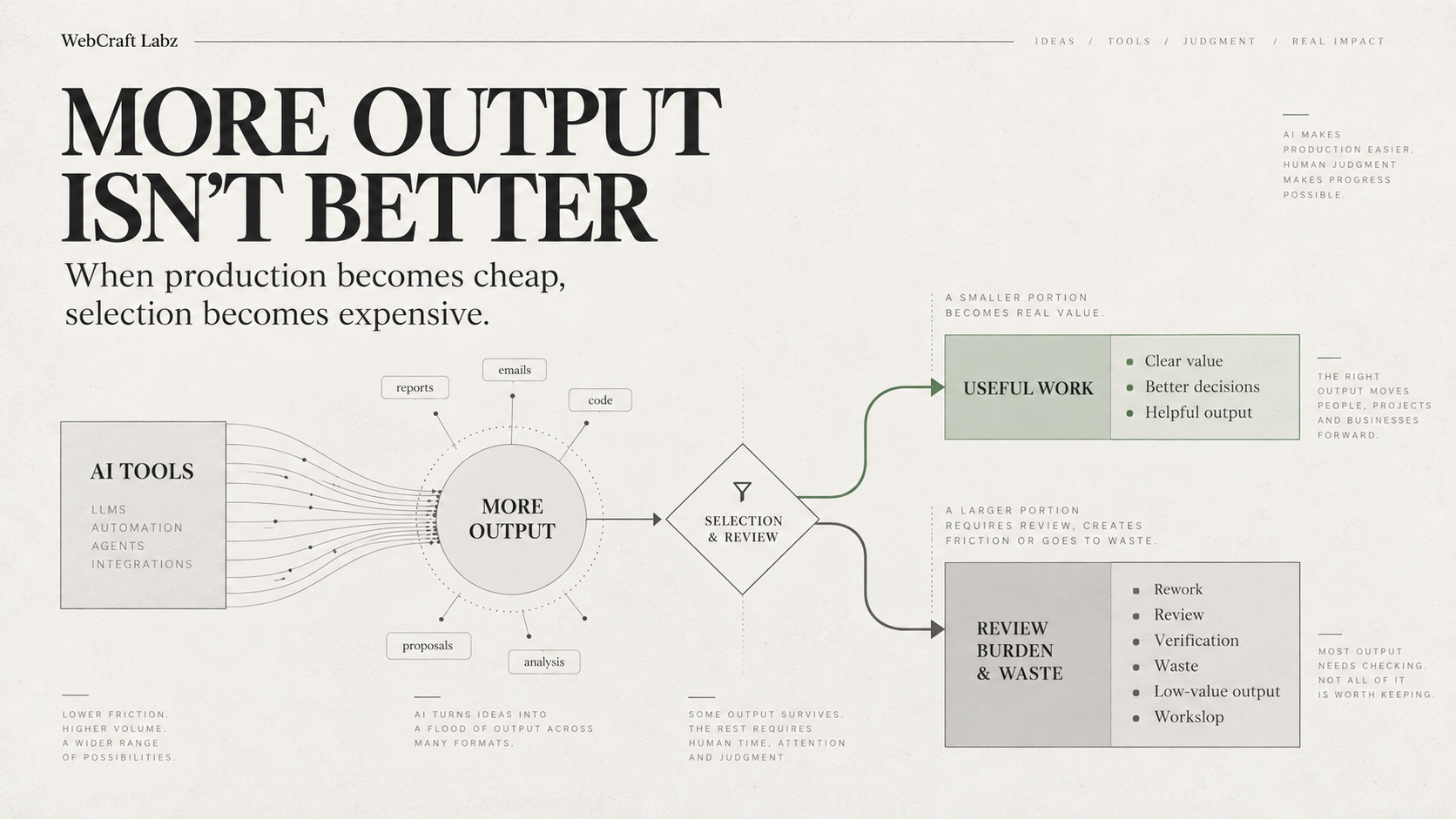
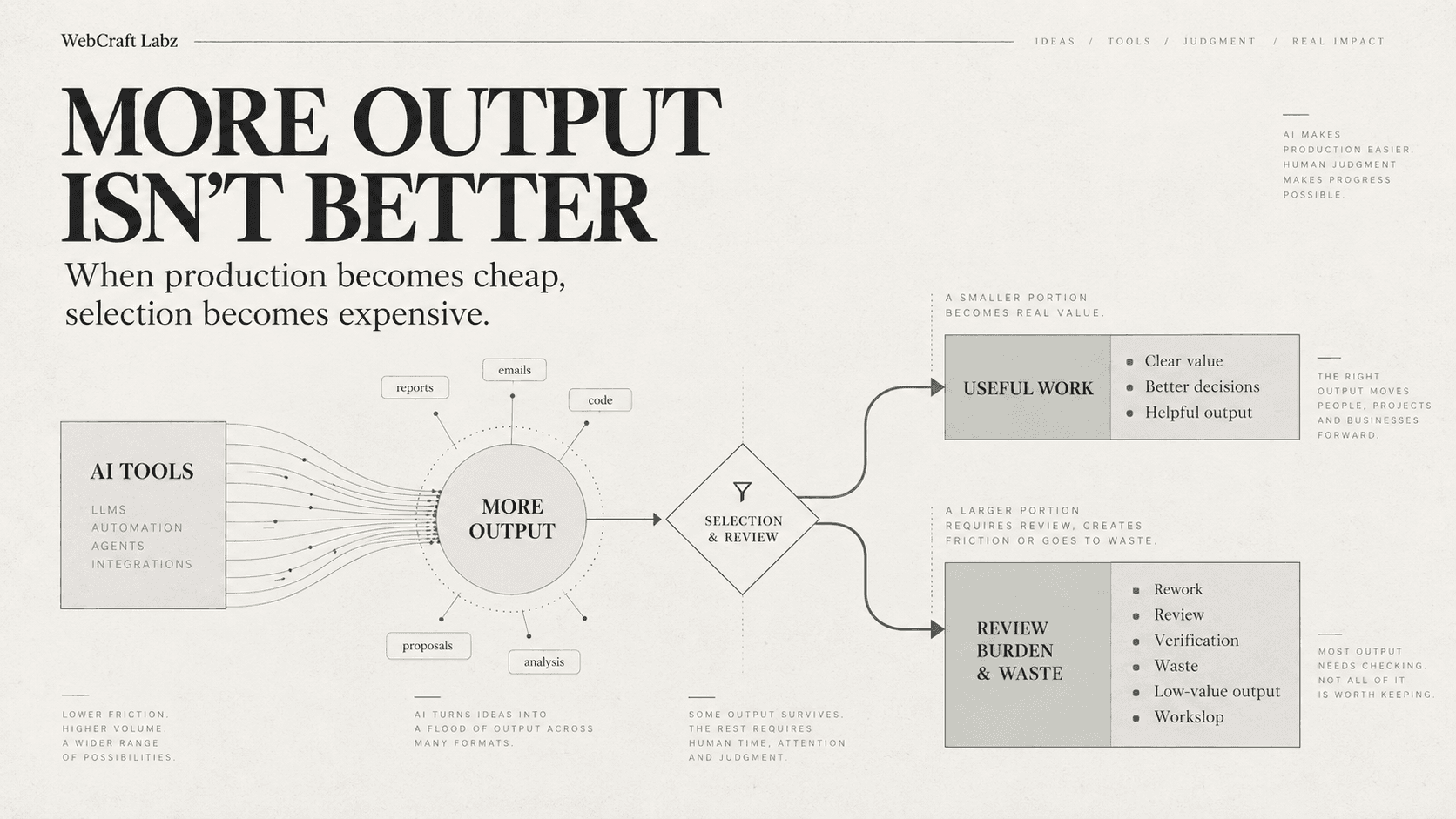
More output isn't better
AI makes it very easy to confuse more with better.
More content.
More code.
More dashboards.
More ideas.
None of that automatically means better decisions, better service, fewer mistakes, or higher margins.
Sometimes it means the opposite.
Researchers at BetterUp Labs and Stanford gave this a name: workslop. AI-generated work that looks finished but doesn't actually move the task forward. In their survey of 1,150 U.S. full-time workers, published in Harvard Business Review, about 40% said they'd received workslop in the past month, and those who had estimated spending nearly two hours dealing with each instance.
Read that again.
The work didn't disappear.
It moved downstream, to the person who had to figure out whether it was any good.
That's the pattern everywhere production gets cheap:
We made the full case for this in software in The Future of Software Development With AI: when code gets abundant, the bottleneck moves to review, integration, and verification.
The same thing is happening to reports, marketing, analysis, and strategy decks.
The scarce skill is no longer making things.
It's knowing which things deserve to exist.
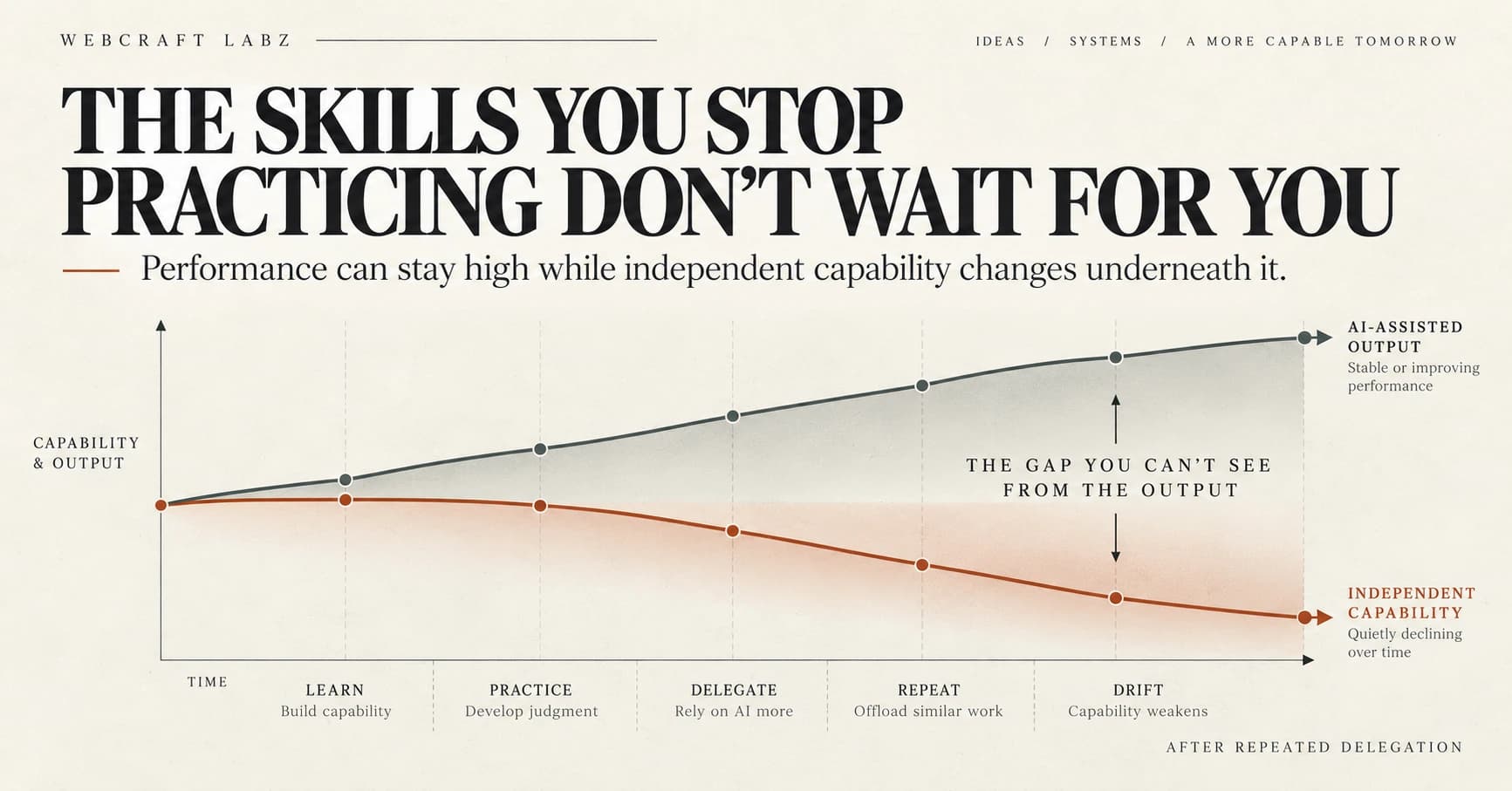
Figure 01
ASSUMPTIONS 03 · The idea to carry away
AI doesn't just automate work. It automates assumptions.
Every workflow in your business runs on rules nobody wrote down.
- What counts as urgent.
- What makes a lead worth calling back.
- What gets rejected.
- What deserves escalation.
- Which data gets trusted.
- What "good" looks like.
For years, those rules lived in people.
The office manager who knows that a small job from a longtime customer matters more than a big job from a stranger.
The account rep who can tell when a "not interested" means "not yet."
The supervisor who knows the system says one thing, but everyone actually does another.
Those assumptions were flexible because they were human. People applied them with context. They bent them when a situation called for it. They noticed when a rule stopped making sense.
Now hand that workflow to AI.
Say a service business sets up AI to score and respond to incoming leads. It learns to prioritize by job size, because job size is in the data.
The office manager's rule, take care of the people who've been with us for years, isn't in the data.
It was never written down.
So it quietly disappears.
Nobody decided to stop valuing loyal customers.
The assumption just wasn't executable, so it didn't make the trip.
That's the real shift:
This is why AI projects so often surface uncomfortable questions that have nothing to do with AI.
What is a qualified lead?
Who decides what urgent means?
Why does the process say one thing while everyone does another?
Humans could live with those ambiguities for years.
Software can't.
THE PROMPT 04 · Zoom out
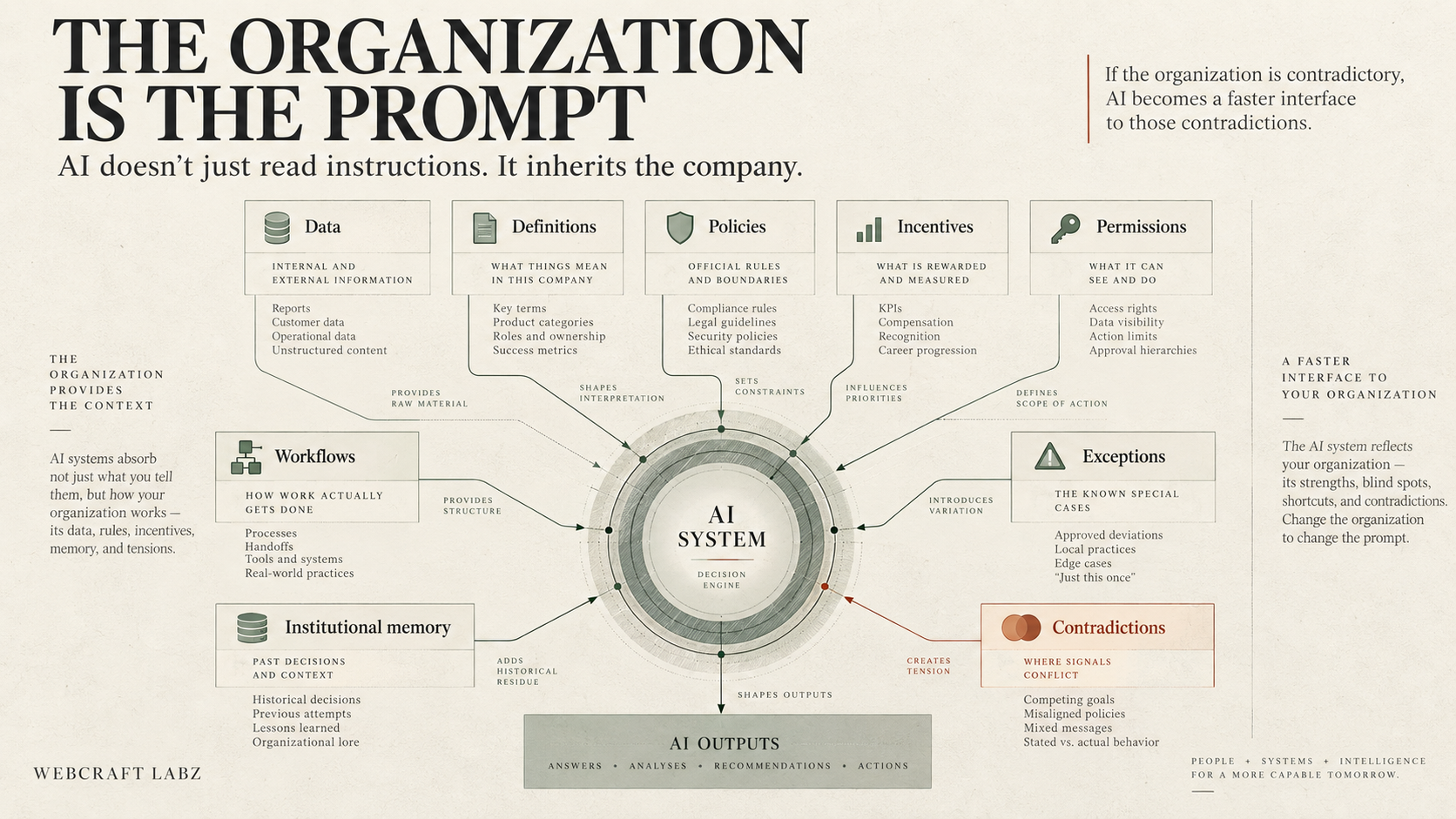
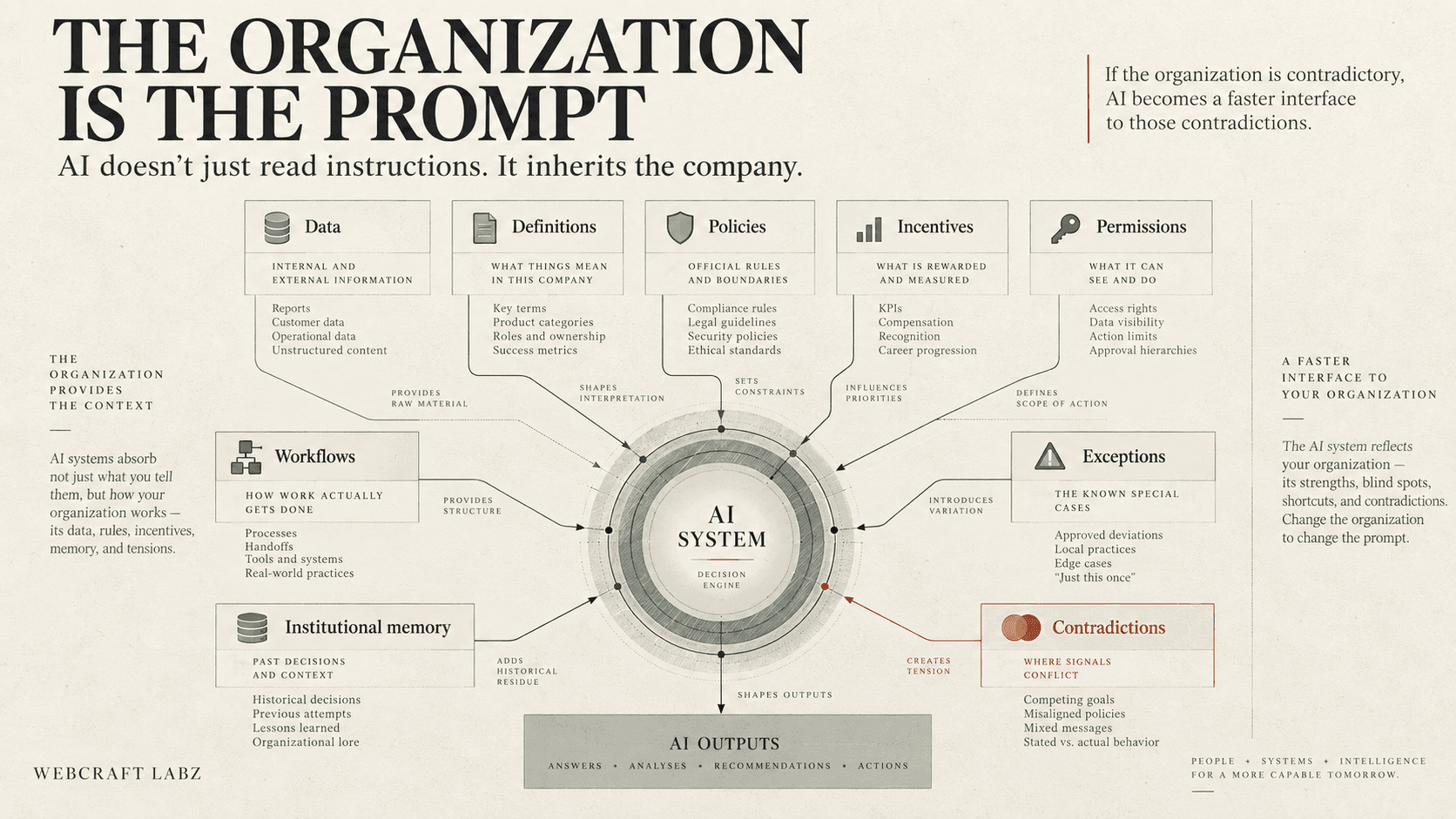
The organization is the prompt
We talk about prompt engineering as if the important prompt is the sentence someone types into a chat box.
At company scale, the real prompt is much bigger.
It's your data.
Your definitions.
Your policies.
Your incentives.
Your permissions.
Your workflows.
Your exceptions.
Your institutional memory.
And your contradictions.
AI reads all of it.
Then it acts accordingly.
If your sales team is rewarded for volume and your support team is rewarded for retention, an AI working across both will inherit that tension. If three systems define "active customer" three different ways, AI won't resolve that. It will pick one, or blend them, or answer differently depending on where it looks.
Which makes AI something nobody quite planned for: a diagnostic instrument.
Point it at your organization and it will find, very quickly, everything you never agreed on.
That's the data side of this problem, and we unpack it in Your Software Stack Is Quietly Creating Five Versions of Your Business.
And the structural side — why those incentives, boundaries, and approval habits exist in the first place — is the subject of Your Company Was Designed for a World That No Longer Exists.
The short version: you can't prompt your way past an organization that doesn't know what it means.
Figure 02
SCALE 05 · Mistakes used to be local
AI can scale bad judgment too
Before automation, one bad assumption usually stayed small.
One person made one wrong call on one report.
Somebody noticed. Somebody fixed it.
AI changes the math.
A flawed assumption built into a workflow doesn't make one mistake.
It makes the same mistake thousands of times, consistently, confidently, and fast.
The risk isn't only that AI gets something wrong.
It's that an organization can industrialize the wrong idea.
And there's a second-order effect.
When everyone can generate polished proposals, analyses, plans, and code in minutes, the world fills up with plausible output.
Plausible is not the same as true.
So a new set of questions becomes valuable:
- Who checked this?
- Where did the data come from?
- Was this actually tested?
- Would anyone notice if it were wrong?
The cost of creating things is collapsing.
As plausible output becomes abundant, the work required to establish trust becomes more valuable.
The workslop research points at this too: recipients reported seeing colleagues who sent it as less capable and less trustworthy. Bad AI output doesn't just waste time. It spends credibility.
OWNERSHIP 06 · Capability doesn't dissolve responsibility
Who owns the decision?
There's a paradox at the center of all this.
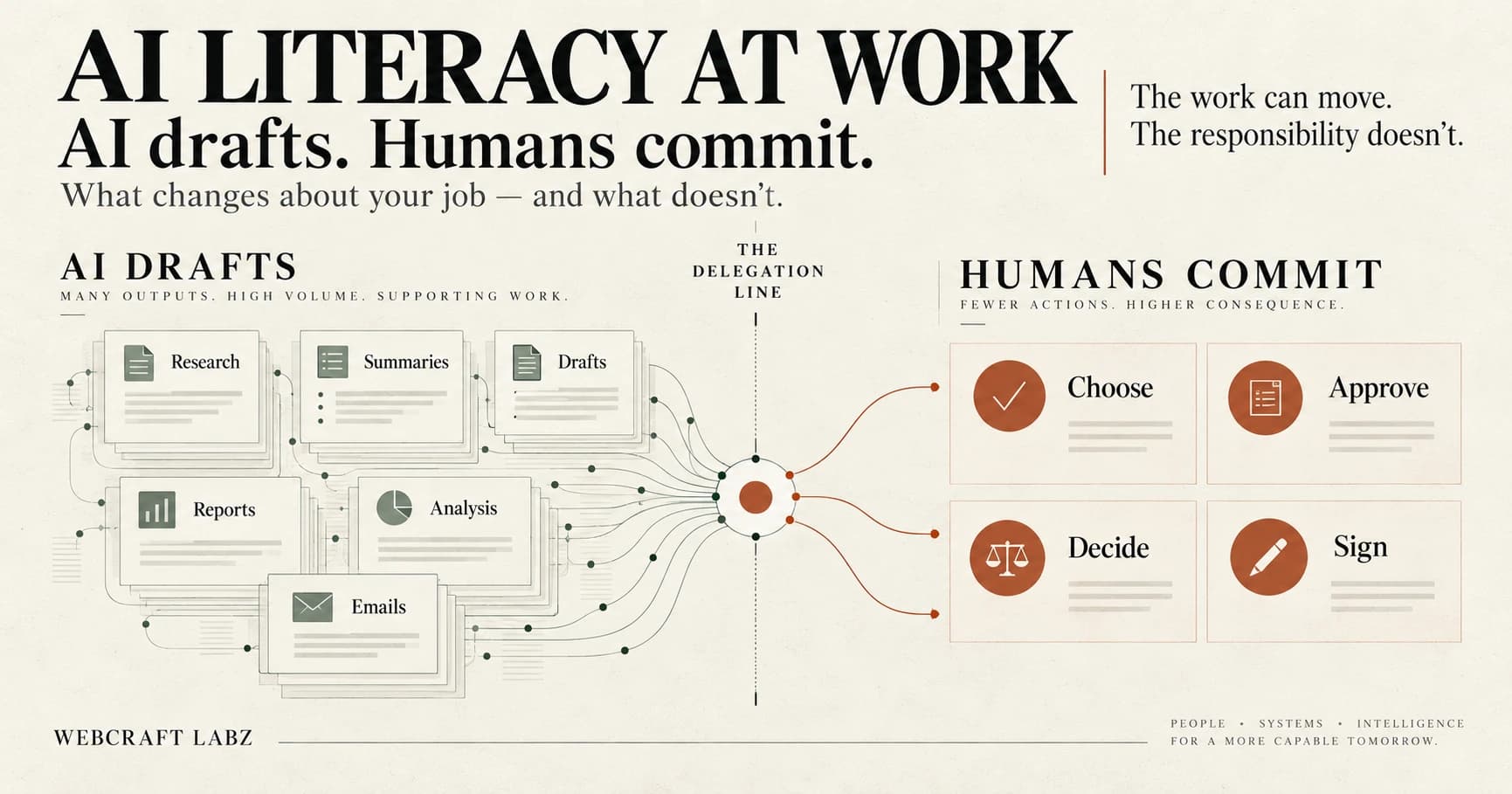
The more capable AI becomes, the easier it is to hand things off.
The more you hand off, the more it matters who is accountable when something goes wrong.
"Human in the loop" has become a comfortable phrase. It often means very little.
The real questions are specific:
- Who verifies the output before it matters?
- Who approves the action?
- Who can override it, and do they know they're allowed to?
- Who is responsible when the recommendation is wrong?
If nobody can answer those, you don't have a human in the loop.
You have a human near the loop.
PRODUCTIVITY 07 · The measurement problem
Productivity needs a new definition
For most of modern business history, productivity meant more output per hour.
That definition made sense when output was expensive.
It stops making sense when output is nearly free.
If AI can produce ten reports in the time it used to take to write one, "reports per hour" measures nothing useful.
What starts to matter instead:
- Better decisions per unit of attention.
- Fewer unnecessary actions, not more actions.
- Faster learning: how quickly the organization notices it's wrong.
- Better outcomes with less noise.
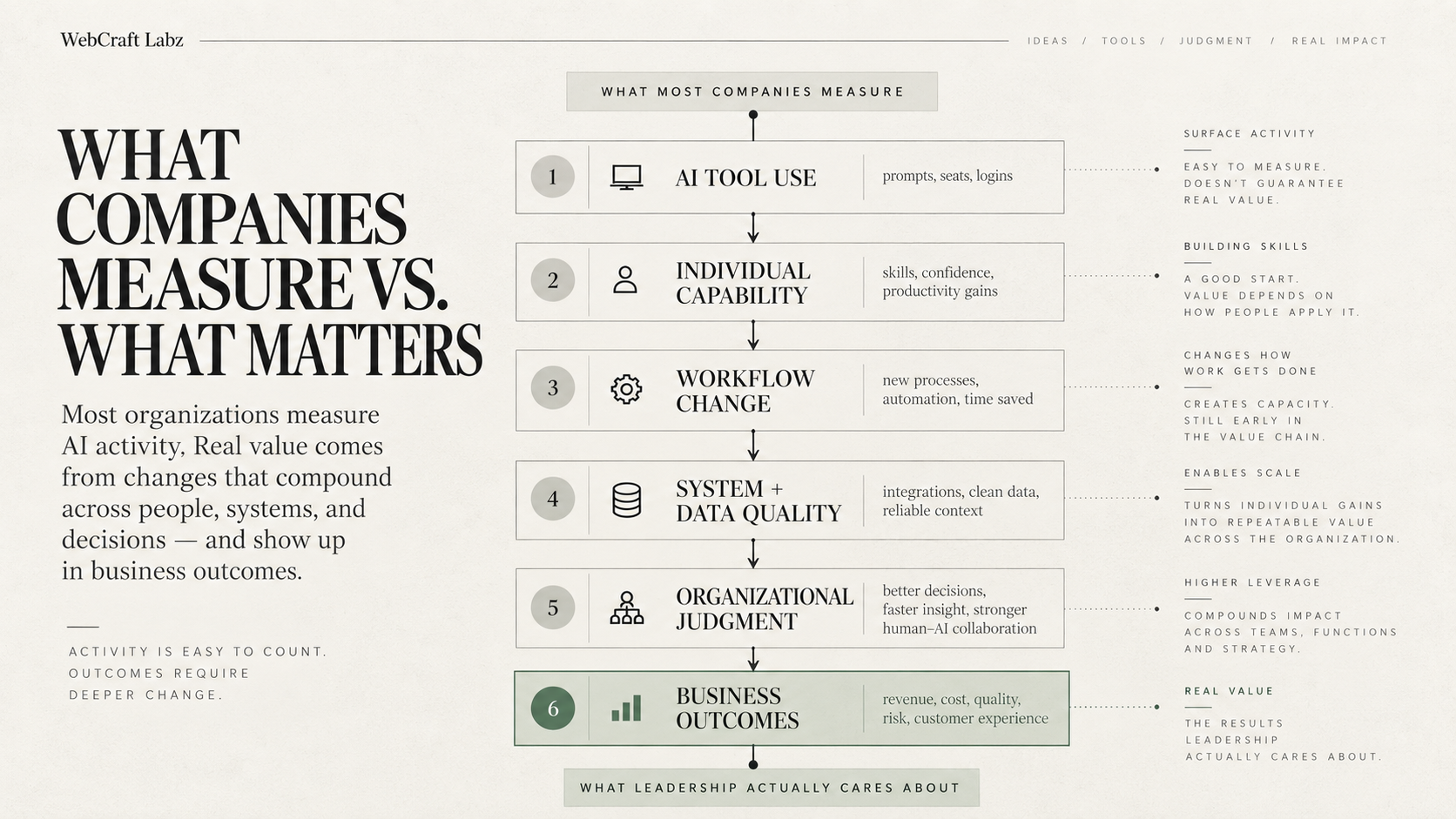
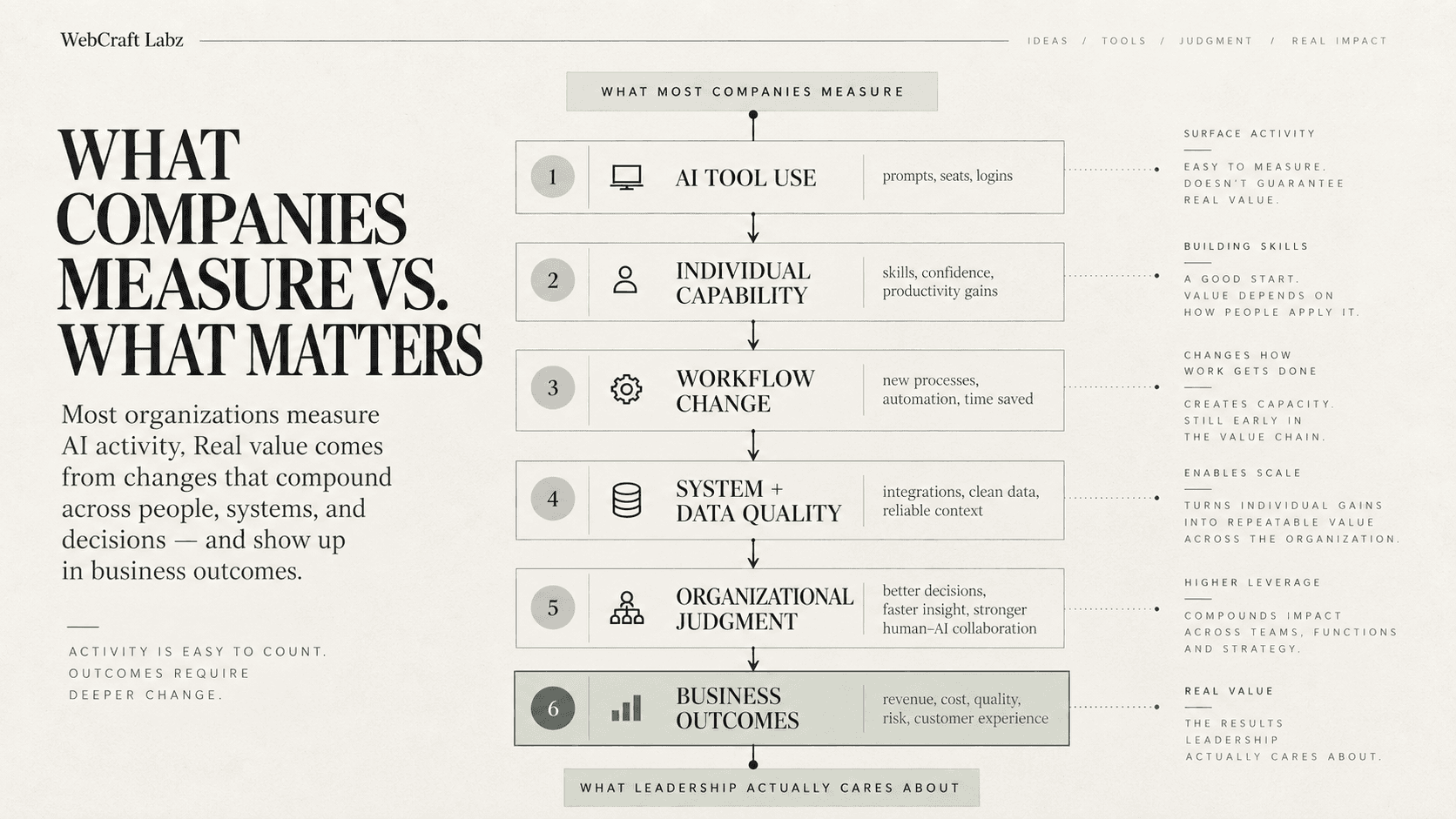
Here's the gap most organizations are living in right now.
Seats, logins, and prompts live at the top.
Revenue, cost, quality, risk, and customer experience live at the bottom.
Everything in between is where the real work is, and where most AI strategies go quiet.
You can't jump from the top of that ladder to the bottom.
Every rung has to hold.
Figure 03
THE QUESTION 08 · What to ask next
Smarter, or just faster?
"Are we using AI?"
is becoming the least interesting question a company can ask.
For many organizations, the answer is already yes.
The harder question is:
Faster is useful.
Faster is also easy to buy.
Smarter has to be built: in how people think, how work flows, what information the business trusts, and who owns the call when it counts.
The companies that learn the difference will get far more from AI than the ones that simply deploy more of it.
Key takeaways
- AI adoption measures activity. AI capability measures outcomes. Most organizations only measure the first.
- More output is not better performance. When production becomes cheap, selection becomes expensive.
- AI automates assumptions. Rules you can express become executable at scale; rules you never wrote down quietly disappear.
- The organization is the prompt. AI inherits your data, definitions, incentives, and contradictions, and exposes what you never agreed on.
- AI can scale bad judgment as easily as good judgment, and as plausible output multiplies, verification and trust become more valuable.
- Capability doesn't dissolve accountability. Someone must own verification, approval, override, and responsibility.
- Productivity needs redefining around decisions, learning, and outcomes, not output per hour.
Follow the problem deeper
The judgment gap rarely has one cause. Start where your bottleneck is:
- If the bottleneck is human judgment: What AI Can't Take From You
- If the bottleneck is software delivery: The Future of Software Development With AI
- If the bottleneck is messy information: Your Software Stack Is Quietly Creating Five Versions of Your Business
- If the bottleneck is legacy processes and systems: System Archaeology: How to Map What Your Business Actually Runs On
- If the bottleneck is approvals, ownership, or authority: Enterprise AI Is Creating a Human Bottleneck
- If the bottleneck is where your next experts come from: Who Will Train the Humans Who Supervise AI?
Research behind this essay
Challapally, A., Pease, C., Raskar, R., and Chari, P. "The GenAI Divide: State of AI in Business 2025." MIT Project NANDA, July 2025. Based on leader interviews, an employee survey, and analysis of public AI deployments. Widely cited for its finding that most organizations in the study saw no measurable P&L impact from generative AI. Its methodology has been debated; treat the headline figure as a signal about one sample, not a universal statistic. Read coverage in Fortune
Niederhoffer, K., Kellerman, G. R., Lee, A., Liebscher, A., Rapuano, K., and Hancock, J. T. "AI-Generated 'Workslop' Is Destroying Productivity." Harvard Business Review, September 2025. BetterUp Labs and Stanford Social Media Lab survey of 1,150 U.S. full-time workers on low-quality AI-generated work and its downstream costs. Time estimates are self-reported. Read the article
Where WebCraft Labz fits
Most AI problems eventually become questions about data, definitions, workflows, and ownership. That is the territory behind our Content, Data & Platform Systems work.
Build Something Better
Ideas deserve a better home than a generic blog.
WebCraft Labz builds fast, polished websites for businesses and creators who want their ideas to feel premium from the first scroll.
Start a ProjectContinue Reading