DATA-CENTRIC ARCHITECTURE
Your Software Stack Is Quietly Creating Five Versions of Your Business
Your CRM, billing platform, website, and spreadsheets can all be correct while disagreeing with each other. This guide explains the data architecture problem underneath that drift and what to do about it.
Your customer exists in your CRM.
They also exist in your billing system.
Probably in your email platform.
Maybe in your scheduling software.
And almost certainly in a spreadsheet someone built three years ago that the company now quietly can't live without.
Here's the uncomfortable part: those systems probably don't agree about who that customer is.
One has the new phone number.
Another has the right billing address.
The CRM says active.
Accounting says closed.
Marketing has them twice, because they signed up with two emails.
Nobody did anything wrong.
Nobody sat down and said:
"Let's run five slightly different versions of our business."
It happened one useful piece of software at a time.
This guide is about the fix for that. It has a name that sounds like it belongs in a Fortune 500 boardroom: data-centric architecture.
The idea is simpler than the name. And by the end, you'll know whether your business needs it, or whether you can safely ignore it.
THE DRIFT 01 · Nobody plans this
How a business ends up with five versions of itself
Start a service business.
You have a website and a phone.
Leads start coming in, so you add a CRM.
You need to get paid, so you add invoicing.
You hire a crew, so you add scheduling.
Customers want to book and pay online, so you add a portal.
Marketing gets serious, so you add email automation.
Somebody wants numbers the tools won't give them.
A spreadsheet appears.
Then another one.
Website
   ↓
CRM
   ↓
Scheduling

Billing
   ↓
Accounting

Email Platform

Customer Portal

Operations Spreadsheet

Reporting Spreadsheet
Every one of those was a reasonable decision.
That's the point.
Nobody chose this architecture. It accumulated.
The trouble shows up later, when the same customer, property, job, or order lives in five places, and each place has learned something slightly different about it.
FIVE MARIAS 02 · Same person. Different records.
Meet Customer #5
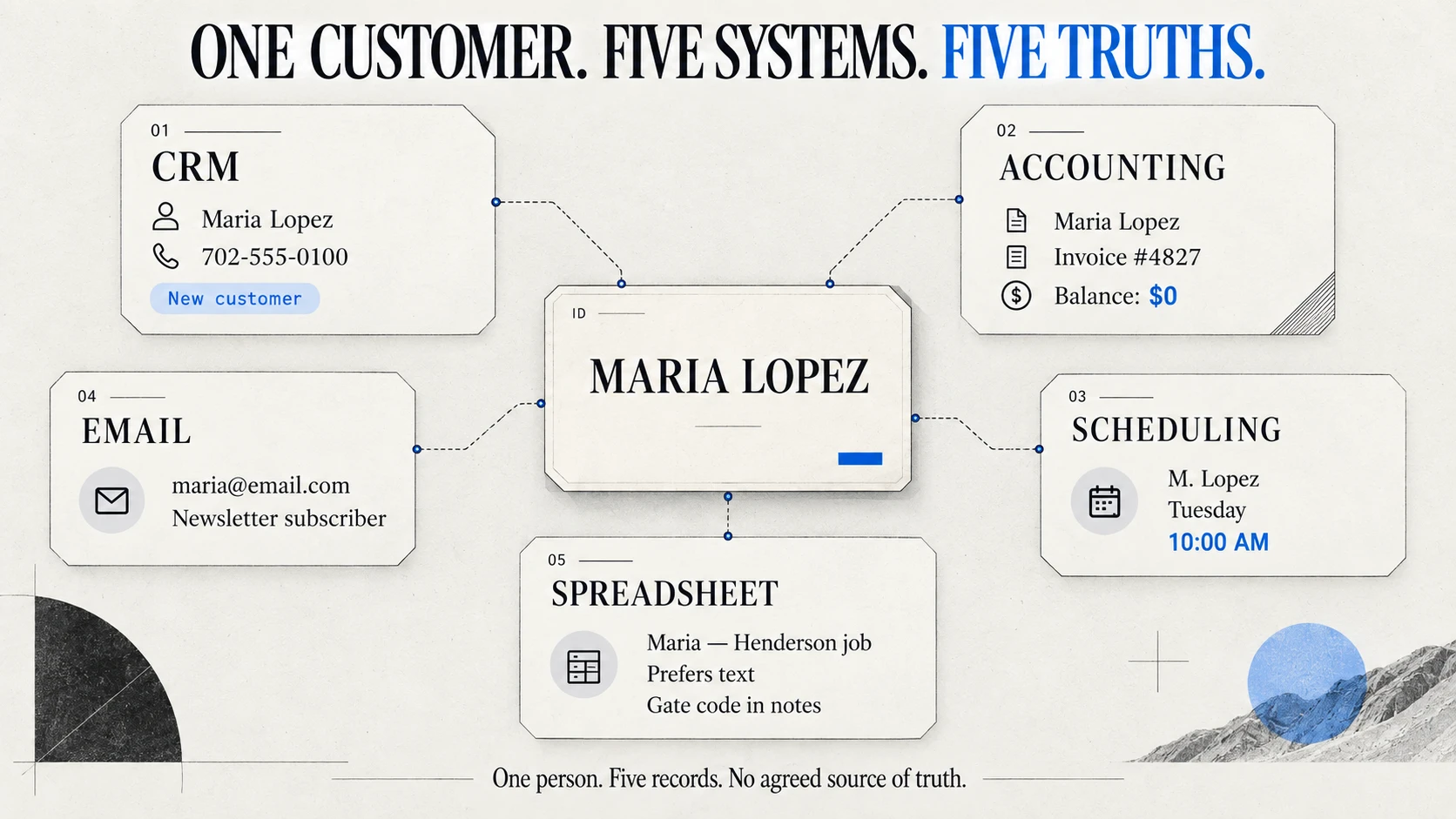
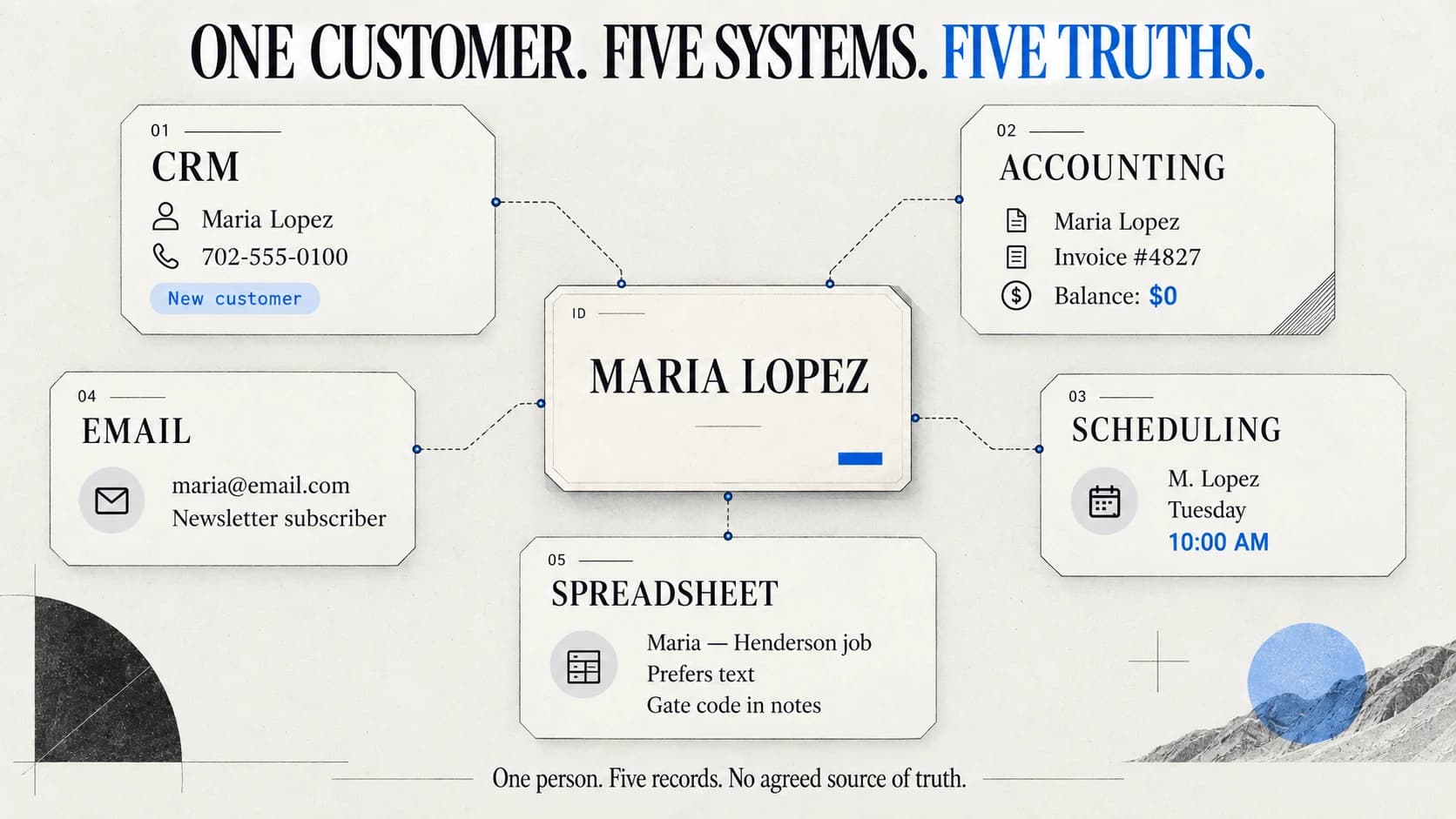
Maria hires your company.
Your CRM knows:
Maria Lopez
702-555-0100
New customer
Your accounting system knows:
Maria Lopez
Invoice #4827
Balance: $0
Your scheduling platform knows:
M. Lopez
Tuesday 10:00 AM
Your email platform knows:
maria@email.com
Newsletter subscriber
And somebody's spreadsheet knows the stuff that actually matters on the job:
Maria - Henderson job
Prefers text
Gate code in notes
Technically, that's one customer.
Practically, your business now has five Marias.
Figure 01
Then Maria changes her phone number.
- Which Maria gets updated?
- Which one knows she's already a customer?
- Which one should your new portal trust?
- Which one should an AI assistant believe?
The problem was never storing data. Every system stored it just fine.
The problem is that nobody decided which information belongs to the business, rather than to whichever app happened to collect it first.
THE FLIP 03 · Change what sits at the center
What data-centric architecture actually means
This isn't a fringe idea. AWS's architecture guidance describes organizations moving away from application-centric designs toward ones where infrastructure, development, and business processes are designed around data. Researchers working with BMW and the University of Oldenburg describe a similar shift in the automotive industry: reducing isolated interpretations of data through more standardized models, context, provenance, and shared semantics.
The shift comes down to which question you ask first.
Application-centric:
What data does this application need?
Data-centric:
What information does the business have, and which applications get to use it?
Small change in wording.
Big change in what you build.
Instead of this, repeated for every tool you buy:
Application
    ↓
Application Data
you move toward this:
                 Shared Data Foundation

             /          |          \
            /           |           \
         Website      Billing       CRM
            \           |           /
             \          |          /
                Operations
The applications don't disappear. They keep their own storage, logic, and interfaces.
What changes is who's in charge.
The application becomes a consumer of business data, not the permanent owner of business truth.
MEANING 04 · The hard part is not storage
The surprisingly difficult question: what is a customer?
Sounds ridiculous. Everybody knows what a customer is.
Until you ask four departments.
- Sales: someone who signed a contract.
- Accounting: someone with an active account.
- Marketing: someone who has ever bought from us.
- Support: anyone we've ever supported, past or present.
All four are reasonable.
Now ask:
"How many customers do we have?"
The database has every number it needs.
You'll still get four correct answers.
That's not a data problem. It's a meaning problem.
This is where architecture conversations start sprouting vocabulary:
- Metadata — information describing other data.
- Schema — rules for how data is structured.
- Taxonomy — a way of classifying things in a domain.
- Ontology — a model of concepts and how they relate.
- Knowledge graph — a connected map of entities and relationships across systems.
You don't need to master any of these to follow the rest of this guide.
They're all tools aimed at one question:
Can two parts of the company look at the same information and understand it the same way?
If the answer is no, more integrations won't save you. They'll just move the disagreement around faster.
ONE BUILDING 05 · Make it concrete
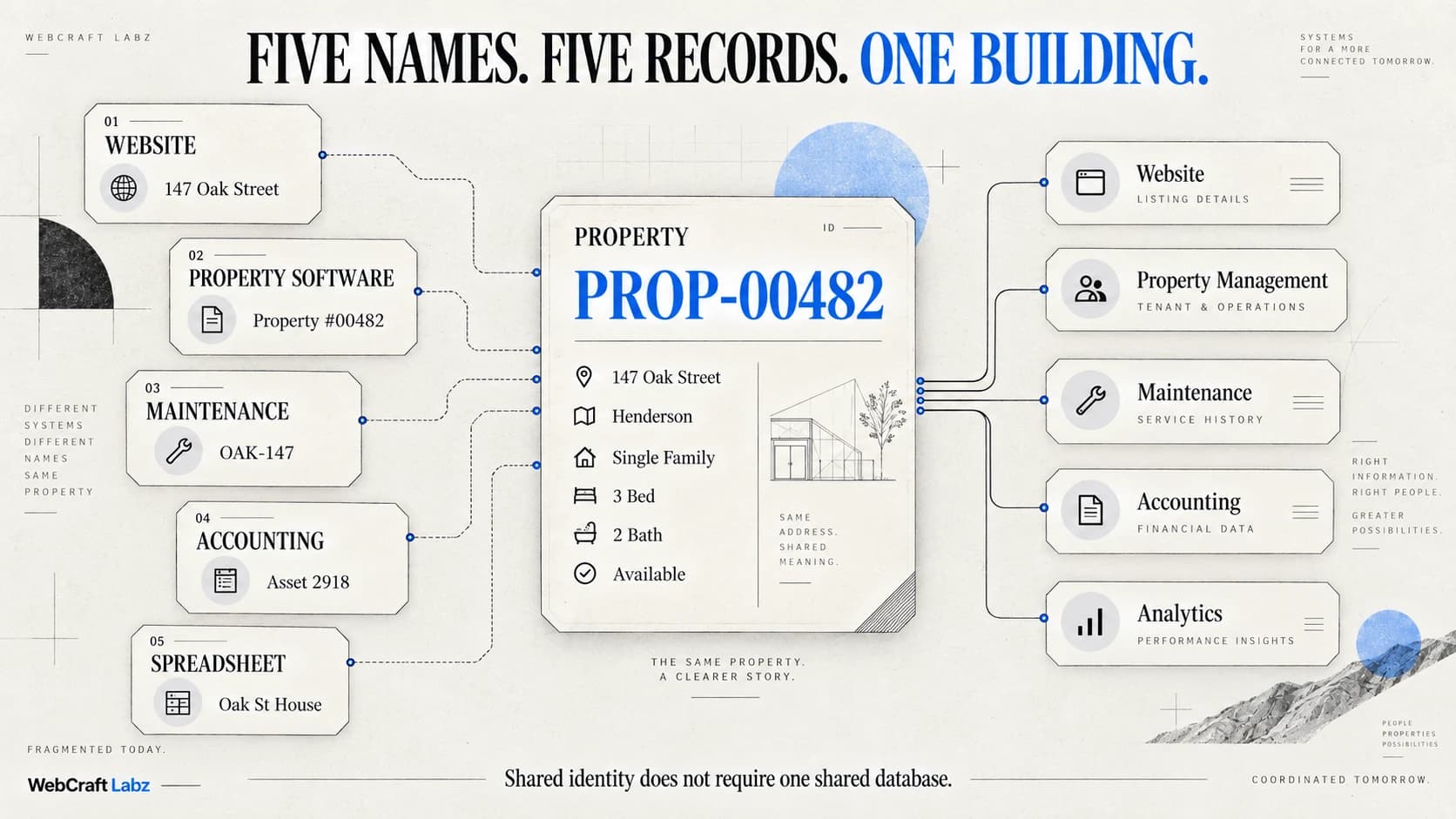
Five names. Five records. One building.
Take a property-management company.
- The website lists available rentals.
- Property software tracks tenants and leases.
- Maintenance software tracks repairs.
- Accounting tracks money.
- Analytics tracks performance.
Every one of them needs to know about the same house.
Here's what that usually looks like:
Website
  └── 147 Oak Street

Property Software
  └── Property #00482

Maintenance
  └── OAK-147

Accounting
  └── Asset 2918

Spreadsheet
  └── Oak St House
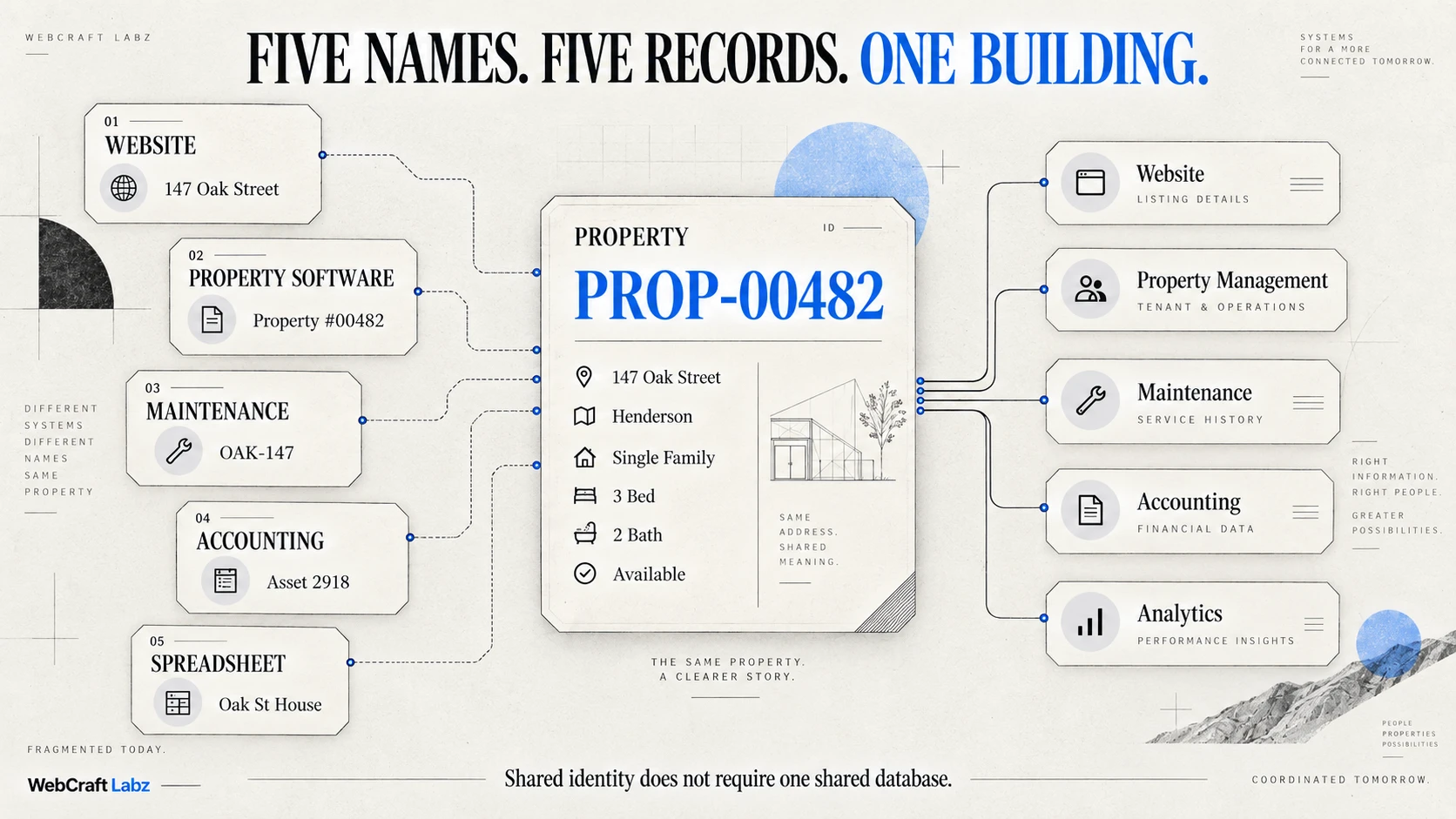
Five names.
Five records.
One building.
Now the company does one thing differently. It decides what a property is, and gives each one a single identity every system uses:
PROPERTY

ID:           PROP-00482
Address:      147 Oak Street
City:         Henderson
Type:         Single Family
Bedrooms:     3
Bathrooms:    2
Status:       Available
That doesn't mean every field moves into one database.
Each system still takes what it needs:
- The website wants photos, bedrooms, amenities, availability.
- Maintenance wants HVAC, appliances, work orders, access notes.
- Accounting wants owner, income, expenses, payments.
They don't need identical databases.
They need to agree that PROP-00482 is the same building.
That's the whole trick. Most of data-centric architecture is that sentence, applied carefully to everything your business runs on.
Figure 02
NOT ONE DATABASE 06 · The most common wrong turn
No, this doesn't mean one giant database
This is where "data-centric" sends a lot of people down the wrong road.
Healthy businesses run on many kinds of systems at once: relational databases, CMS platforms, object storage, APIs, event streams, warehouses, search indexes, analytics tools. Different jobs need different tools.
Modern architecture mixes centralized and decentralized approaches:
- A data mesh spreads ownership of data across business domains, held together by shared standards.
- A data fabric connects and governs information that lives in many places.
- A knowledge graph maps relationships between data that stays where it is.
- A data lake stores large volumes of raw data without becoming every app's operational database.
These overlap. None of them alone is data-centric architecture.
Our take: dumping everything into one place doesn't make it understandable. It just trades a bunch of small silos for one very large one.
GROWTH 07 · Hidden knowledge has a shelf life
Why this gets worse as you grow
Small businesses survive inconsistent data because people fill the gaps.
Someone in accounting knows Maria moved.
The office manager knows "Oak St House" and Property #00482 are the same place.
The owner knows which spreadsheet is actually current.
That knowledge is invisible infrastructure. It's holding the whole thing up.
Growth breaks it. More people, more tools, more automation, and suddenly the knowledge that kept everything consistent lives in the heads of two employees, one of whom just gave notice.
That's when the cracks show: reports disagree, automations fire at the wrong time, customers get two emails, and replacing any single tool feels like defusing a bomb.
Figuring out what's actually running your business is its own discipline. We cover it in System Archaeology: How to Map What Your Business Actually Runs On. That guide is the discovery step. This one picks up where it leaves off: once you know what you have, decide what belongs to the business instead of any one app.
Two quick warnings before we move on.
Integrations have a tipping point. Past a certain number of tools, you stop buying software and start building a system out of other companies' software, held together with automations and spreadsheets. Sometimes the expensive part of a SaaS stack is everything holding it together. That's the real starting point for custom software vs. off-the-shelf tools.
Your website can join the pile. Accounts, payments, scheduling, live availability, dashboards, and persistent records can push a website toward becoming part of the operational system. The important boundary is whether it starts maintaining state, applying business rules, or owning data other systems depend on. We explore that line in When Your Website Becomes Software.
AI 08 · Old problem, new consumer
AI makes the problem impossible to ignore
AI didn't invent messy business data.
It just made messy data a lot more ambitious.
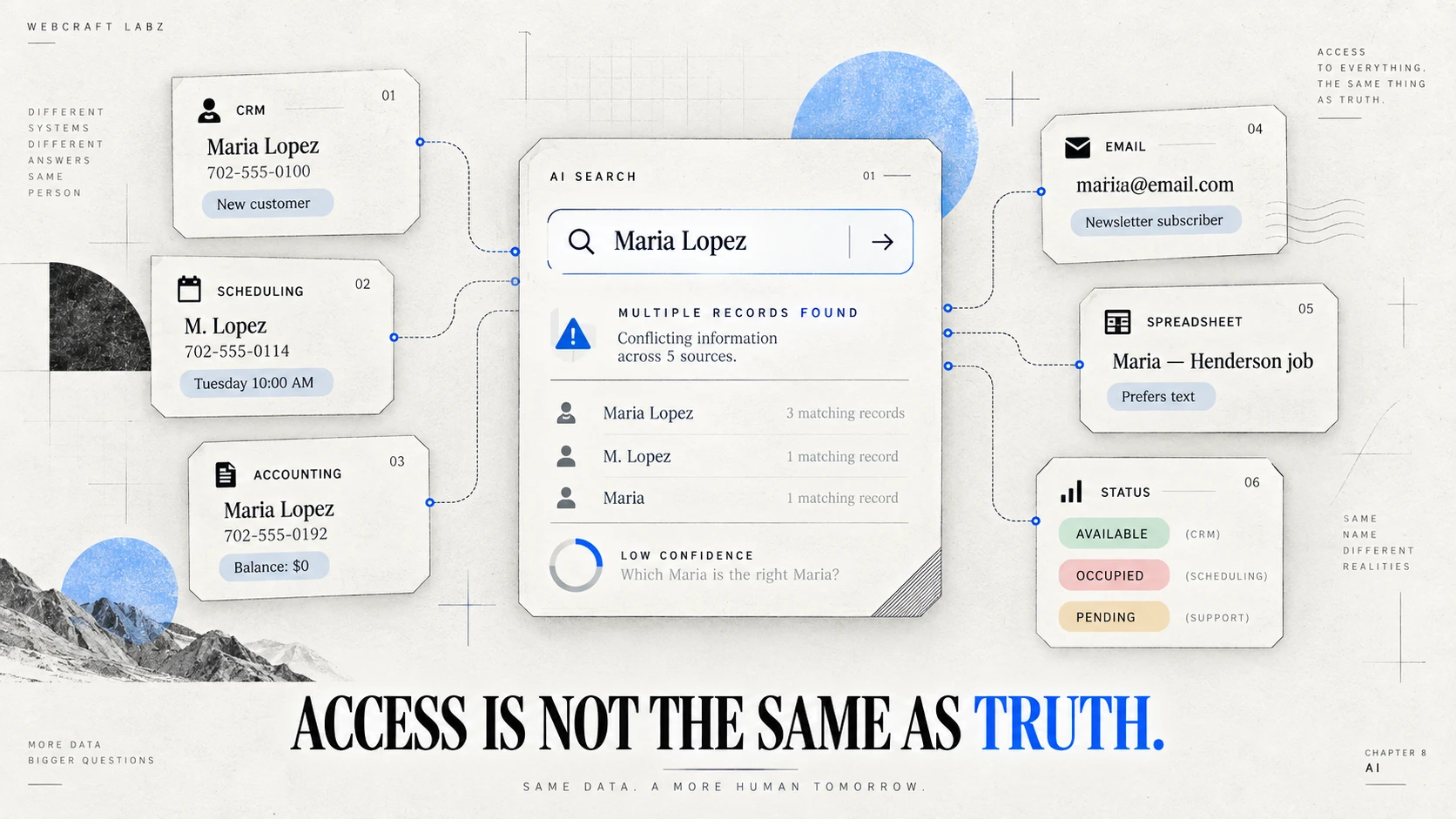
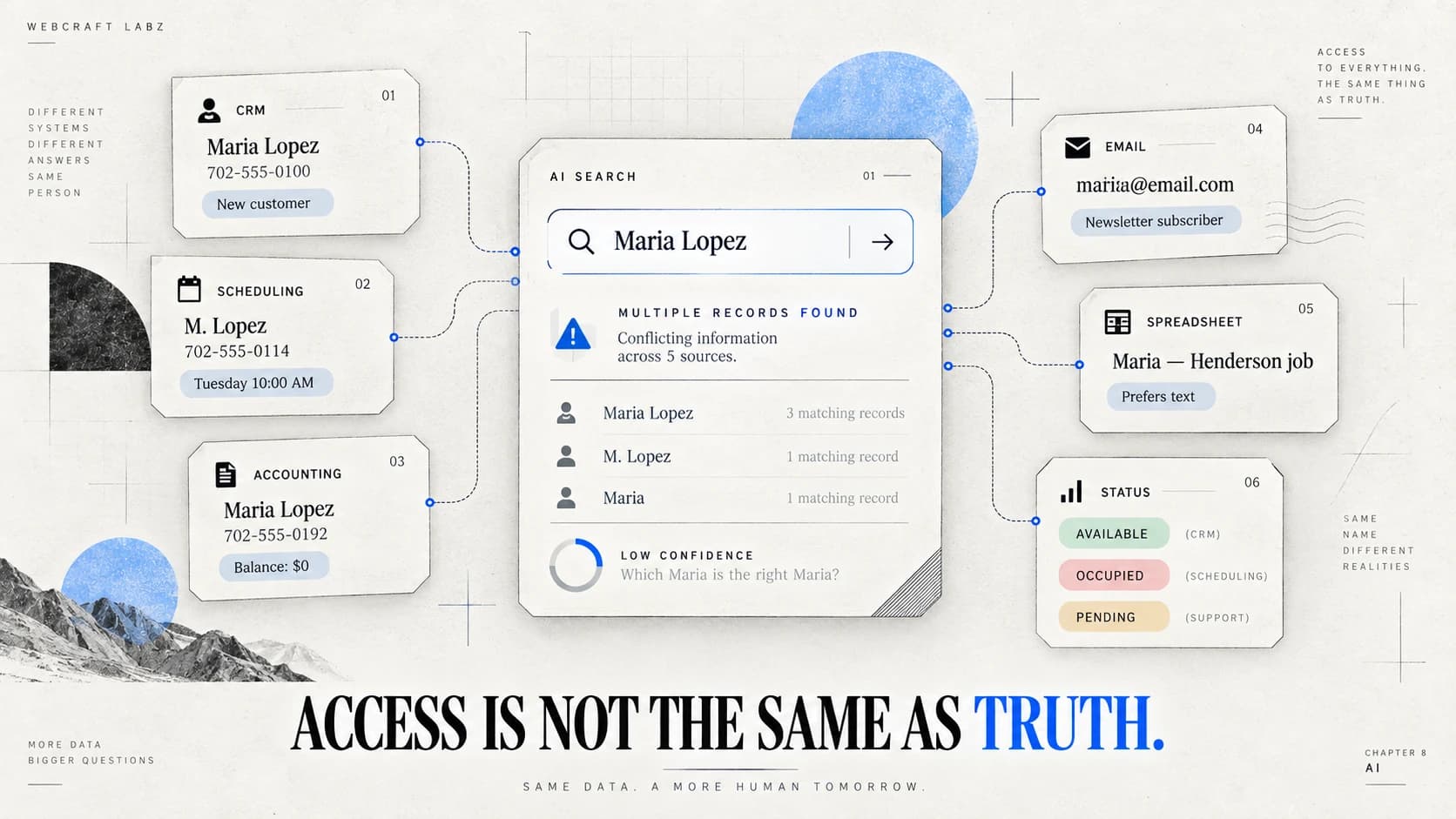
Connect an AI assistant to your CRM, billing, support tickets, email, documents, and scheduling.
Then ask:
"Give me everything we know about this customer."
Which Maria does it believe?
Figure 03
Or ask:
"Which properties are actually available?"
The website says available.
Property management says occupied.
The spreadsheet says "pending."
AI can retrieve all three answers in under a second.
It cannot decide what your business means by "available."
A better model doesn't resolve a business definition your organization has never agreed on.
That's an information architecture problem.
AI needs more than access. It needs context: what things mean, how they relate, where information came from, whether it's current, and what it's allowed to touch.
A shared data foundation makes those questions answerable.
It doesn't answer them for you.
Related: The Future of Software Development With AI looks at what happens after trustworthy systems are in place, when generation gets faster than review, integration, and verification.
TRADEOFFS 09 · Not a magic cleanup button
So why doesn't everyone build this way?
Because the principle is easy and the implementation isn't.
Data-centric architecture doesn't delete complexity. It moves it.
Somebody has to decide what things mean
What is a customer? What counts as active? What identifies a property? Who owns that definition, and what happens when it changes?
Getting departments to agree takes far more coordination than letting each team quietly create another table.
Data can't ignore physics
Data that lives far from the app using it is slower. Data copied to several places has to stay in sync. Systems that need instant consistency run straight into distance and network reliability.
Chris Evans' work on data mobility lays out the real compromises: added latency, stale or inconsistent copies, reduced availability, partitioning, and higher storage costs.
Architecture can't wish away distributed systems.
Governance can turn into bureaucracy
Shared data needs owners. Owners make decisions. Decisions need process.
Get that wrong and every field change needs approval from six committees and a ceremonial gong.
When the official path is painfully slow, people build shortcuts.
The shortcuts become the new silos.
Somebody has to run it
Doing this well touches data modeling, governance, APIs, integrations, security, and data engineering. AWS's guidance treats data-engineering capability as a core part of making this work.
The perfect architecture nobody can operate is not the perfect architecture.
FIT 10 · Honest answer: maybe not
Does your business actually need this?
A three-person business with one CRM and QuickBooks does not need an Enterprise Semantic Governance Council.
Please do not put that meeting on the calendar.
Architecture should solve problems, not manufacture ceremonies.
The trigger isn't company size. It's information complexity. A ten-person shop with twelve tangled SaaS tools can have a messier data environment than a company fifty times its size.
DON'T CONFUSE IT 11 · Similar names, different ideas
What data-centric architecture is not
Not "data-driven." A data-driven business uses data to make decisions. Data-centric architecture is about how that data is structured, owned, and shared underneath. Plenty of companies are data-driven on top of a mess. They just pay for it in cleanup, every single reporting cycle.
Not "data-centric AI." That's about improving the datasets used to train or run machine-learning models. Related, overlapping, different job.
Not "database-centric." That describes software built around one central database. Data-centric architecture may involve many databases, plus APIs, streams, and warehouses. The center is the data, not the database.
START HERE 12 · No new software required
Start with nouns, not tools
Here's something you can do this week without buying anything or talking to anyone.
Write down the nouns your business runs on:
Customer
Property
Job
Product
Employee
Appointment
Invoice
Order
Work Request
Then ask one question about each:
Where does this live?
Put it in a grid. We call it a business data map:
| Business object | CRM | Billing | Website | Scheduling | Spreadsheet | Who's in charge? |
|---|---|---|---|---|---|---|
| Customer | ✓ | ✓ | ✓ | ✓ | ✓ | ? |
| Property | ✓ | ✓ | ✓ | ✓ | ? | |
| Appointment | ✓ | ✓ | ✓ | Scheduling | ||
| Invoice | ✓ | ✓ | Billing |
Every ? in that last column is a decision your business has been avoiding.
Then go row by row:
- Which version is authoritative?
- Which systems hold copies?
- Which fields disagree?
- What happens when the record changes?
- What has to survive if one of these tools disappears tomorrow?
That map will tell you more about your architecture than any vendor demo ever will.
Only then decide whether you need better integrations, fewer tools, a shared data model, a new CMS, custom software, or simply clear rules about which system owns what.
Sometimes the answer really is just the rules.
The one idea to keep
Application-centric thinking says:
This app's data belongs to this app.
Data-centric thinking says:
This is business data. Apps are allowed to use it.
Your CRM might change.
Your CMS might change.
Your billing provider might change.
Your scheduling software almost certainly will.
Your customers, properties, jobs, and history need to survive all of it.
That's the part worth designing around — and once you know which data has to survive, deciding which systems stay, get connected, get replaced, or get switched off becomes a much smaller question.
Key takeaways
- Software stacks fragment gradually. Most silos start as reasonable decisions to solve individual problems.
- Data-centric architecture treats important business information as a persistent, shared asset instead of something each app owns forever.
- It is not one giant database. Systems can store data differently while sharing identities, definitions, and sources of truth.
- The hardest part is meaning, not storage. Two accurate systems can still disagree about what a customer or property is.
- AI exposes fragmented data fast, because it has to work across systems that don't agree.
- It has real costs: semantic modeling, governance, skills, latency, and sync. Build enough architecture, not maximum architecture.
- Start with a business data map: list your nouns, find where each one lives, and decide who's in charge of it.
Keep exploring the system
This guide answers one question: what changes when important business data has to survive the applications using it?
The surrounding guides answer the questions on either side of it:
- First, map what actually exists: System Archaeology: How to Map What Your Business Actually Runs On
- Then, understand the data problem: this guide
- Next, identify the website/software boundary: When Your Website Becomes Software
- If the answer points toward replacing or building software: Custom Software vs. Off-the-Shelf: A Build-vs-Buy Framework
Together they form a practical path from discovery → data ownership → system boundaries → build decisions.
Research behind this guide
This guide translates academic and industry research into plain language. It isn't based on any single vendor's definition, and it doesn't recommend any particular platform.
Alvarez-Coello, D., Wilms, D., Bekan, A., and Marx Gómez, J. "Towards a Data-Centric Architecture in the Automotive Industry." Procedia Computer Science, Vol. 181, 2021, pp. 658–663. Data as a shared asset, reducing redundant copies, standardized and semantic models, provenance, and the move from application-centric to data-centric design. Read the paper
Patrikar, A. and Gantaram, S. "Best practices for designing and implementing modern data-centric architecture use cases." AWS Prescriptive Guidance. The shift from application-centric to data-centric architecture, with data treated as a core IT asset. Read the AWS guidance
Evans, Chris. "Data-Centric Architectures – Data Mobility." Architecting IT, 2021. The practical tradeoffs: latency, replication, consistency, data locality, and storage cost. Read the article
McComb, Dave / Semantic Arts. The Data-Centric Manifesto and related writing. The most influential practitioner voice for application-independent data. Best read alongside independent academic and industry sources, not as a neutral definition on its own. Read Semantic Arts' discussion
One last question
If you replaced your CRM tomorrow, how much of your business would have to be rebuilt around it?
Now ask the same thing about your billing platform.
Your scheduling software.
Your website.
If the answers keep getting uncomfortable, the problem probably isn't any one application.
It's the architecture connecting all of them.
That's the work we do in Content, Data & Platform Systems: map what you actually have, decide what belongs to the business, and only then decide what to connect, replace, consolidate, or build.
Build Something Better
Ideas deserve a better home than a generic blog.
WebCraft Labz builds fast, polished websites for businesses and creators who want their ideas to feel premium from the first scroll.
Start a ProjectContinue Reading