Your Company Was Designed for a World That No Longer Exists
Modern organizations were built around the cost of human coordination. Software changed faster than organizational structure, leaving behind coordination tax, accidental architecture, and fragmented systems. AI may finally force us to redesign the operating system underneath the business.
Organizations were built around the cost of moving information through people. That cost is changing. The structures built around it mostly haven't.
We Digitized the Business. We Didn't Redesign It.
Organizations have never owned more software.
CRMs manage customers. Project platforms manage work. Dashboards track performance. Shared drives store documents. Chat tools connect teams. Automation platforms shuttle information between applications. AI assistants can now draft, summarize, classify, research, analyze, and increasingly act on behalf of the people using them.
The average organization operates with a technology stack that would have looked almost absurdly powerful twenty years ago.
And yet the work often does not feel dramatically simpler.
Employees still copy information between systems. Managers chase status updates. Approvals disappear into email threads. Teams maintain spreadsheets because they do not completely trust the software that supposedly replaced them. Meetings are held to explain what dashboards were supposed to make obvious.
Organizations frequently possess the information required to answer a question and still cannot answer it because that information lives in different systems, under different owners, using different structures.
That is the contradiction worth examining.
We spent two decades digitizing organizations without fundamentally redesigning how they operate.
Sometimes what we call digital transformation is really analog bureaucracy wearing a digital interface.
To understand why that matters, it helps to go backward first.
The structures that now appear slow, complicated, or bureaucratic were not created randomly.
They evolved to solve a very real constraint.
Organizations Were Built Around the Cost of Coordination
For most of modern business history, information was expensive to move.
A customer request did not route itself. A supplier problem did not arrive with all the relevant context attached. A maintenance issue did not automatically find the person capable of resolving it. A compliance question did not search policy, determine who had authority, record the decision, and notify everyone affected.
People did those things.
Someone received information, interpreted what it meant, determined where it belonged, handed it to another person, followed up, and eventually reported what happened.
Organizations built machinery around that reality.
Departments created specialization. Managers coordinated work. Hierarchies established authority. Meetings synchronized information. Forms standardized inputs. Procedures reduced ambiguity. Approval chains managed risk.
These structures were not bureaucratic merely for the sake of bureaucracy.
They were rational responses to a world in which human beings were the primary network connecting the organization together.
If information could only travel reliably through people, then people had to be arranged carefully enough to move it.
The problem is not that this model was wrong.
The problem is that one of its fundamental constraints is changing while much of the architecture built around that constraint remains.
The Coordination Tax
Every organization pays a hidden cost for moving work through itself.
It rarely appears as a clean line item because it is distributed across ordinary activity: reading requests, categorizing them, assigning ownership, asking for clarification, waiting for approval, updating records, following up, checking completion, and reporting status.
Each step may be necessary.
But much of that activity exists because work has to move through the organization before value can be created.
A basic workflow might look like this:
Request
   ↓
Intake
   ↓
Interpretation
   ↓
Assignment
   ↓
Approval
   ↓
Execution
   ↓
Follow-up
   ↓
Reporting
In many organizations, a human sits between almost every stage.
The individual cost can appear trivial: a short Slack message, an email asking for clarification, ten minutes spent preparing an update. Across hundreds of employees and thousands of transactions, those tiny transfers compound into meaningful operating cost.
The more complex the organization becomes, the more coordination it requires. That coordination creates roles responsible for managing other roles, which creates another layer that itself needs coordination.
Eventually a surprising amount of organizational energy is spent simply maintaining awareness of what the organization is already doing.
There is good reason for some of that activity. Coordination is not inherently wasteful.
A September 2026 NBER study of more than 9,000 workers found that meetings consumed about 12 percent of working hours and 14 percent of firm wage bills. But the same research also found that meetings supported planning, problem solving, knowledge sharing, coordination, and employee learning.
The lesson is not that coordination should disappear.
It is that coordination is expensive enough that organizations should be deliberate about where human coordination genuinely creates value.
No individual meeting, report, handoff, or approval necessarily looks absurd from the inside.
That is precisely why the coordination tax is difficult to see.
No One Designed the System You're Running On
There is another problem sitting underneath the coordination tax.
Almost nobody intentionally designed the complete system their organization currently depends on.
It accumulated.
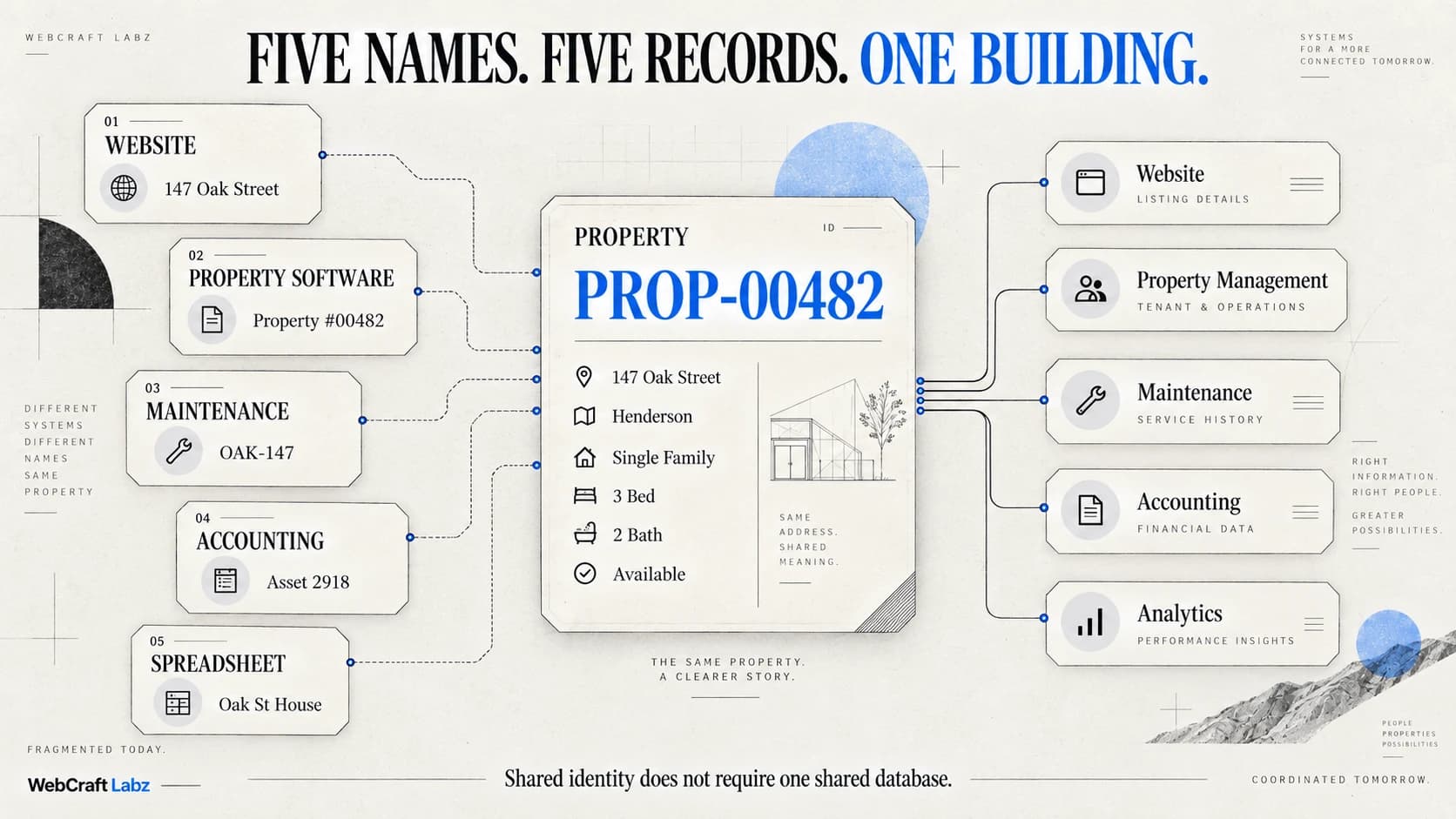
A company bought accounting software because it needed accounting software. Sales adopted a CRM. Marketing added an email platform. Operations chose a project-management tool. Documents moved to the cloud. A payment processor was connected. Analytics arrived. Another department purchased specialized software. A vendor built an integration.
Eventually two important systems could not communicate properly, so somebody created a spreadsheet to bridge the gap.
The spreadsheet worked.
Five years later, it was critical infrastructure.
This pattern repeats for decades.
Each decision makes sense locally, but the combined result was never designed as one coherent architecture.
Technology geology may be even more accurate.
ERP. CRM. Email. PDFs. Shared drives. Legacy databases. Cloud applications. Vendor portals. Custom integrations. Old APIs. And, inevitably, a workbook named FINAL_v2_UPDATED.
Every layer solved a problem.
Every layer eventually became connected to something else.
Because each component now supports some part of the organization, replacing one can disturb several others.
This is why modernization becomes harder than replacing individual software products.
You are rarely replacing only a website, CRM, or database.
You are touching an ecosystem of assumptions that formed around it: where information originates, who owns it, which system is authoritative, who can modify it, which departments depend on it, what happens when something unusual occurs, and which workaround quietly keeps everything functioning.
That is the real architecture.
We call that result Accidental Architecture, and finding your own is a discipline in itself — System Archaeology is the method for excavating it before anything gets replaced. The rest of this essay takes up the other half of the problem: the organization that grew up around that architecture is also the thing that has to change.
Every Organization Is Running Two Operating Systems
This helps explain why expensive digital-transformation programs can produce surprisingly modest organizational change.
Every organization effectively runs two operating systems at once.
Technical Operating System
- Website and digital interfaces
- CMS and document platforms
- CRM and ERP systems
- Databases and APIs
- Payments and registration
- Search and analytics
- Identity and access systems
Organizational Operating System
- Who receives a request
- Who has authority to decide
- Where information is supposed to live
- How work gets assigned
- How exceptions escalate
- How departments coordinate
- How outcomes are measured
The technical operating system is visible. It appears in architecture diagrams, vendor contracts, budgets, and technology roadmaps.
The organizational operating system is harder to see because it lives in habits, authority structures, institutional knowledge, meeting cadences, approval rules, department boundaries, workarounds, and trust.
Most modernization focuses on the technical side.
A new website launches while the approval chain behind it remains unchanged. A CRM is replaced while employees continue maintaining the spreadsheet they trust. A real-time dashboard appears, but the same meeting still exists because the decision process never changed.
The software improves.
The organizational logic underneath it remains intact.
That is why an organization can become highly digitized without becoming particularly adaptive.
It has better tools, but work still flows through the same structure.
The Productivity Trap
This distinction becomes especially important with AI.
The first wave of adoption has understandably focused on individual productivity.
Write the email faster. Analyze the document faster. Generate the report faster. Produce the presentation faster. Create the code faster. Research the question faster.
Those gains can be real. We have written about rebuilding a personal workflow around AI and the time it genuinely returns.
But individual productivity and organizational productivity are not the same thing.
One of the clearest demonstrations comes from a field experiment involving 7,137 knowledge workers across 66 firms.
Researchers gave selected workers access to generative AI inside applications they already used for email, meetings, and writing. Among workers who used the tools, AI reduced email time by roughly two hours per week.
But beyond those individual time savings, researchers did not detect meaningful changes in the overall quantity or composition of work.
The worker changed faster than the organization around them.
Imagine the same principle across an entire company.
Employees suddenly produce far more output, while the approval process, review capacity, decision structure, integration process, and implementation capacity remain unchanged.
The likely result is not an equivalent increase in value.
It is more work arriving at the same constraint.
The organization has increased production without increasing its ability to absorb production.
A faster report matters only if someone can act on it. More leads matter only if sales can process them. More code matters only if it can be reviewed, tested, integrated, deployed, and supported. More analysis matters only if it improves a decision.
This is already becoming visible at the executive level.
A 2026 NBER study surveying nearly 750 corporate executives found positive reported productivity effects from AI, but also documented a productivity paradox: perceived productivity improvements were larger than measured improvements.
Feeling faster and becoming measurably more productive are not necessarily the same thing.
Telling them apart is its own problem, because activity is easy to count and capability is not. Is Your Company Getting Smarter, or Just Faster? takes up that measurement gap directly.
AI can dramatically accelerate one stage of a system without changing the stage that actually limits the final outcome.
The bottleneck moves. That same pattern is now visible inside software itself, where code became abundant and the constraints moved downstream toward review, verification, and integration.
Don't Automate Broken Architecture
This is where many modernization strategies will go wrong.
They will identify inefficient work and immediately ask:
How do we automate this?
Sometimes that is exactly the correct question.
Sometimes it locks a bad design in place.
If three departments maintain duplicate versions of the same information, automation could synchronize the databases more quickly. But perhaps the more important question is why three competing sources of truth exist at all.
If six approvals are required for a routine request, AI could prepare the paperwork and chase each approver automatically. But perhaps only two approvals are actually managing meaningful risk.
If employees manually convert emailed documents into database records, AI could perform the conversion beautifully. But perhaps the information should have entered the system in structured form from the beginning.
Automation improves execution inside an existing process.
Modernization is willing to question the process itself. That is also the difference between buying another tool and deciding, deliberately, which parts of an operation to rent and which to own.
Before adding intelligence, organizations need to understand the architecture intelligence is entering.
Otherwise AI risks becoming another layer of accumulated technology.
A particularly powerful one.
But another layer nonetheless.
From Digital Transformation to Operating-System Design
A modern organization therefore needs more than newer software.
It needs an architecture based on different assumptions.
Information should have clear ownership. Systems should expose important data instead of trapping it. Interfaces should reflect user intent rather than internal department structures. Routine coordination should happen automatically where appropriate. Human judgment should be concentrated around ambiguity, risk, creativity, accountability, negotiation, and empathy.
Most importantly, individual systems should be able to evolve without forcing everything around them to be rebuilt.
This is a different modernization philosophy.
It does not begin with:
What software should we buy?
It begins with:
How should information, decisions, and work move?
Only then does technology enter the conversation.
A useful modernization sequence looks something like this:
1. Start with the outcome
What is the organization actually trying to accomplish?
Not the department responsible for it. Not the current workflow. The outcome.
2. Map the information
What does the organization need to know to produce that outcome? Where does the information originate? Which system should own it? That last question is harder than it looks once the same customer or invoice exists in four systems with four slightly different versions — deciding which one is authoritative is the subject of Your Software Stack Is Quietly Creating Five Versions of Your Business.
3. Map the decisions
Which steps follow clear rules? Which require interpretation? Which require judgment, accountability, or discretion?
4. Remove unnecessary coordination
Which handoffs exist because specialization is genuinely useful, and which exist because systems cannot communicate or the process simply grew that way?
5. Design the architecture
Only after the first four steps should the organization decide where APIs, automation, AI, databases, interfaces, and human oversight belong.
That is the point where modernization stops being software procurement and becomes systems design.
Then the Intelligence Layer Starts to Make Sense
Once the underlying architecture is understood, AI becomes much more interesting.
Not as a chatbot in every department.
Not as a replacement for management.
Not as a giant autonomous brain running the company.
A better model is an interpretation and coordination layer.
Traditional automation is excellent at structured rules.
If a payment succeeds, send a receipt.
If a status changes, notify the customer.
If an invoice becomes overdue, create a reminder.
Organizations, however, also deal with enormous amounts of unstructured information: emails, documents, questions, contracts, reports, notes, complaints, conversations, and free-form requests.
Historically, humans have acted as the translation layer between that messy information and structured software. They determine what something means, find the relevant context, and decide where it belongs.
AI can increasingly participate in that translation.
There is an economic reason to think the effect could eventually reach beyond individual tasks.
A 2026 NBER model treats production as chains of steps that can be performed manually, augmented by AI, or executed in connected AI-driven sequences. As those sequences change, the model shows that the optimal way firms bundle steps into tasks and tasks into jobs can change too.
In other words, improving individual tasks may not be the endpoint.
Once enough neighboring steps can be coordinated differently, the structure of the work itself can change.
                 HUMAN JUDGMENT
                        ↑
                        │
              ┌─────────────────┐
              │  INTELLIGENCE   │
              │      LAYER      │
              ├─────────────────┤
              │  Interpret      │
              │  Retrieve       │
              │  Route          │
              │  Execute        │
              │  Monitor        │
              │  Escalate       │
              └─────────────────┘
                        │
        ┌───────────────┼───────────────┐
        ↓               ↓               ↓
     PEOPLE          WORKFLOWS        SYSTEMS
                                         ↓
                                        DATA
The important idea is not autonomy.
It is connectivity with context.
The intelligence layer can understand a request, retrieve information from multiple systems, determine which workflow applies, perform routine actions, and bring a human into the process when judgment is actually required.
That is qualitatively different from adding another productivity tool.
It changes the connective tissue between people, workflows, and systems.
Five Generations of the Organizational OS
Zoom out and the evolution becomes easier to see.
Timeline
OS 1.0
Paper
Forms, filing cabinets, memos, telephone calls and physical approvals. People moved nearly all information manually.
OS 2.0
Digital
Email, spreadsheets and databases digitized information, but much of it remained trapped inside individual systems.
OS 3.0
SaaS
Specialized cloud platforms transformed individual functions while creating a new problem: fragmentation.
OS 4.0
Automation
APIs, workflow engines, RPA and triggers began moving structured information between systems automatically.
OS 5.0
Intelligence
Systems can increasingly interpret unstructured information, understand context, coordinate tools and escalate exceptions.
The fifth generation is different because the boundary between human-readable information and machine-actionable information becomes less rigid.
Earlier software required people to translate messy reality into forms, fields, categories, and commands before machines could act.
Intelligent systems can increasingly participate in that translation themselves.
Once the cost of interpretation and coordination changes, the organization can begin changing with it.
Residents Don't Experience Your Org Chart
This becomes especially clear in public-facing institutions.
Imagine a parent visits a park district website and asks:
What swimming programs are available for my seven-year-old near me this Saturday?
To the parent, that is one question.
Answering it accurately may require a program catalog, age-eligibility rules, facility records, geographic data, schedules, live capacity, registration inventory, accessibility information, fees, and an external registration or payment system.
Those systems may have been purchased from different vendors, in different years, by different departments.
The resident does not care.
They experience one park district.
The organization may be coordinating eight systems behind the scenes.
That difference is where architecture becomes visible.
The quality of the answer is not primarily determined by the design of the search box. It depends on whether the underlying information is structured consistently, whether systems can exchange it, whether availability is current, where accessibility information lives, which source is authoritative, and whether the interface can retrieve all of it coherently.
This idea already appears in mature public-service design frameworks.
The UK Government Service Standard tells teams to design around the whole problem users are trying to solve, even when that requires working across organizational boundaries. Its guidance makes the principle explicit: users should not have to understand how government is structured in order to use government services.
Yet many institutional websites do exactly that.
Their navigation mirrors internal structures:
Parks Department → Recreation Division → Aquatics → Youth Programs
The resident thinks:
Where can my kid swim Saturday?
That is both an information-architecture problem and an organizational-architecture problem.
The interface is exposing the structure underneath it.
That is why a modern municipal website is increasingly more than a publishing platform.
It is the public-facing layer of a larger service architecture.
Designing Around Questions Instead of Departments
This principle extends well beyond park districts.
A customer does not necessarily care whether a problem belongs to sales, support, billing, or operations. A university student may not know whether a question belongs to admissions, registration, financial aid, housing, or student services. A resident should not need to understand which municipal department owns a permit, road closure, recreation program, or public record.
Those boundaries matter internally.
They should not automatically determine the external experience.
Modern systems can increasingly organize information around intent.
What is this person trying to accomplish?
What information is required?
Which systems contain it?
What workflow should follow?
Who needs to become involved?
That changes the role of the interface.
The website stops acting merely as a directory describing the organization and becomes a service layer helping people interact with it.
That is a much more interesting modernization problem than simply redesigning pages.
Accessibility Is Architecture Too
Public-sector modernization adds another constraint that exposes the same underlying principle — what an interface is capable of is decided by the architecture underneath it, not by the interface itself.
Accessibility cannot simply be applied to a finished interface after the architecture has already been decided.
Under the current U.S. Department of Justice Title II web and mobile accessibility rule, state and local government web content and mobile applications generally must conform to WCAG 2.1 Level AA. The rule also covers content and services governments provide through contractual and other arrangements.
In April 2026, DOJ extended the compliance dates. Larger public entities now have until April 26, 2027, while entities serving populations under 50,000 and special district governments have until April 26, 2028.
That makes accessibility a systems problem.
It affects components, content models, PDFs, video, registration systems, vendor platforms, procurement decisions, workflows, testing, and governance.
A perfectly accessible homepage does not create an accessible digital service if the resident eventually lands inside an inaccessible third-party registration flow.
Accessibility therefore belongs in the architecture.
Not in the final polish.
Adapt or Collapse Is Really About Architecture
Adaptation does not mean ripping out every legacy system when a new technology appears.
That would create permanent instability.
Adaptability means designing systems that can change without requiring the entire organization to change with them.
Structured content can move across channels. APIs allow systems to exchange data. Modular architecture allows components to be replaced. Shared models reduce duplication. Design systems keep interfaces consistent. Accessibility becomes a property of the system rather than remediation added at the end. Observability makes failure visible. Governance establishes who owns information and decisions. Human checkpoints remain where accountability genuinely matters.
AI becomes one capability inside that architecture rather than the architecture itself.
The organization becomes less brittle.
That may prove more valuable than being first to adopt every new technology because the technologies will keep changing.
The enduring advantage is the ability to absorb change without repeatedly rebuilding the organization around it.
Why Smaller Teams May Have an Opening
Large organizations possess capital, talent, infrastructure, and data.
They also possess history.
A fifty-thousand-person institution may require years to change a core workflow.
A five-person company can change one on Wednesday and discover by Friday that it was wrong.
That speed matters.
Smaller businesses, agencies, districts, nonprofits, and entrepreneurial teams may be able to skip some of the architecture larger organizations accumulated over decades.
They can build around structured information earlier, choose interoperable services instead of monoliths, reduce coordination before adding administrative headcount, and design workflows with machine intelligence already assumed.
The goal is not to eliminate people.
It is to reserve people for the work where people create the most value: relationships, judgment, strategy, creativity, negotiation, accountability, and unusual situations.
A six-person organization designed this way might allow systems to handle lead capture, qualification, scheduling, context gathering, reminders, routine document preparation, reconciliation, monitoring, and reporting.
The advantage is not:
Six employees were replaced.
The advantage is:
Six people can coordinate an amount of activity that previously required a much larger administrative structure.
That is a different kind of leverage.
The Organization That Learns
There is another implication that may ultimately matter more than productivity.
Organizations generate operational evidence constantly: searches, transactions, customer questions, service requests, complaints, failed forms, approvals, maintenance tickets, registration patterns, support conversations, delays, and exceptions.
Most organizations capture only fragments of what those events are telling them.
Information disappears into databases. Reports compress it. Employees notice patterns informally. Managers make improvements when those patterns become obvious enough.
The learning loop is slow.
An intelligence-native organization could increasingly shorten it.
WORK
 ↓
DATA
 ↓
PATTERNS
 ↓
FRICTION
 ↓
REDESIGN
 ↓
BETTER WORK
The system does not merely execute workflows.
It also helps reveal where those workflows are failing.
That suggests a more useful definition of an intelligent organization:
Not an organization filled with AI.
An organization increasingly capable of learning from its own operation.
That may be the more important destination.
The Question Leaders Should Be Asking
Many organizations will spend the next several years asking:
Where can we use AI?
That question is understandable.
It is also too small.
A better modernization process asks where information enters the organization, where it becomes duplicated, where context disappears, which decisions require genuine judgment, which steps exist because systems cannot communicate, which approvals reduce actual risk, and which systems contain the authoritative version of important information.
Those are diagnostic questions, and answering them is closer to an afternoon's work than a strategy cycle. Enterprise AI Is Creating a Human Bottleneck walks one real workflow end to end, measures waiting time rather than working time, and sorts what it finds into the five places work actually stops.
Then comes the harder question:
Sometimes the answer will be yes.
Old does not automatically mean obsolete.
Safety controls matter. Human accountability matters. Privacy matters. Accessibility matters. Institutional knowledge matters. Regulation matters.
Some friction exists for excellent reasons.
Strategic modernization requires distinguishing essential constraints from accidental ones.
That is why this work ultimately requires more than technology expertise.
It requires systems thinking.
What This Actually Means
Every organization is, at least partly, a solution to the problem of coordinating human beings.
Factories solved one version of that problem. Bureaucracies solved another. Corporations solved another. Email changed the equation. Cloud software changed it again. Automation changed it again.
Each generation of institutional design reflected the technological constraints available at the time.
Machine intelligence changes another one of those constraints: the assumption that interpretation, routing, retrieval, summarization, and coordination always require human attention.
That does not make people less important.
It changes where human attention creates the greatest value, and it changes the architecture organizations can reasonably build around it. The capacities that remain distinctly human are precisely the ones worth designing the system around.
The central question is therefore not:
What can AI automate?
That question searches for individual tasks to remove while leaving the surrounding organization mostly untouched.
The more important question is:
What kind of organization would we design if intelligent coordination had existed from the beginning?
That is not really a question about chatbots.
It is a question about technical architecture, information architecture, organizational design, and human judgment being designed together instead of accumulated separately.
Most organizations will spend the next several years making their existing operating systems faster.
The ones worth watching will ask whether those are still the operating systems they want to run.
And that may be where the real advantage begins.
WebCraft Labz explores and builds modern digital systems for organizations navigating the shift from websites and disconnected software toward integrated, accessible, and adaptable infrastructure.
Build Something Better
Ideas deserve a better home than a generic blog.
WebCraft Labz builds fast, polished websites for businesses and creators who want their ideas to feel premium from the first scroll.
Start a ProjectContinue Reading